How to Create a Business Budget When Income Changes Monthly
A good month in business can feel like a deep breath. Then a late invoice, a quiet launch, or an unexpected expense can make that confidence disappear fast.
A business budget variable income plan gives your money a job before it gets pulled in too many directions. A monthly budget can work with fluctuating income. You don’t need perfect numbers, just an honest starting point, a conservative baseline, and a rhythm you can keep when life and business both get busy.
Start with what is dependable, then let each strong month build more breathing room.

Key Takeaways
- Build your monthly plan around a conservative baseline income, not your highest or average month.
- Keep revenue, profit, available owner pay, taxes, and business expenses in separate categories.
- Pay fixed expenses and other essential costs first, then transfer a planned amount to yourself for household needs.
- Set aside money for taxes, annual bills, an emergency fund, and lean months before spending on upgrades or extras.
- Review cash flow, unpaid invoices, and upcoming bills every week so a slow month doesn’t become a crisis.
Start With a Conservative Baseline Budget
Income that changes monthly needs a different kind of plan. You cannot spend as if every month will look like your best month.
Look back at the past six to 12 months. List what you actually collected, not what you invoiced or hoped would arrive. Track expenses by category, including business expenses, and identify your lowest normal month. That number becomes your baseline income.
Find your dependable income floor
A baseline income is the amount you can count on during a slower season. It should cover the essential fixed expenses required to stay open, plus a realistic owner-pay amount if your business supports your household.
Don’t use a random low month caused by a vacation, illness, or one-time pause. Instead, look for the lowest amount that appears possible in a regular working month.
If your collected revenue ranged from $3,500 to $8,000, a $3,500 baseline keeps your plan grounded. Any money above that number is helpful, but it isn’t promised. Revisit your baseline income as your work patterns and income history change.
Separate revenue, profit, and owner pay
Revenue is all the money your business brings in. Collected revenue isn’t the same as profit. Profit is what remains after direct costs and operating expenses.
Net monthly income, or available owner pay, should only refer to money remaining after taxes, reserves, planned obligations, and the costs needed to run the business. You can safely transfer that amount after those priorities are covered.
An unpaid $1,200 invoice isn’t cash you can use today. It belongs in accounts receivable until the payment clears, which makes it important to include in your cash flow planning. Use a simple P&L statement guide to review revenue, costs, operating expenses, and net profit in the right order.
A full bank account can include tax money, client deposits, and cash needed for bills next week. It isn’t all available to spend.
Keep Business and Personal Money Separate
When you’re the owner and the worker, it’s easy for money to blur together. A client payment lands, groceries are needed, and a software renewal is due. Soon, there’s no clear picture of your personal finances or what the business can afford. Separate accounts create that picture.
Give each account one clear job
Use a dedicated business checking account for client payments and business expenses. If you can, add separate savings accounts or labeled categories for taxes and reserves. A high-yield savings account may be appropriate for money that can stay untouched.
Your personal account is for household spending. Transfer owner pay into it on a planned schedule, even if that amount is smaller in the beginning.
The SBA’s guidance on separating business and personal finances explains how this habit can reduce bookkeeping confusion and help protect personal assets.
Keep three types of savings apart
Your business reserve keeps operations moving. It can cover software, insurance, inventory, payment-processing fees, or a needed replacement charger.
Your personal emergency fund covers household needs such as rent, groceries, child care, medical expenses, and family emergencies.
A buffer fund has a shorter job. It covers short-term cash flow gaps between a completed project and a late payment. Keeping these funds separate makes your decisions more honest and less stressful.
Use a Zero-Based Budget for Every Deposit
A zero-based budget doesn’t mean your bank balance must stay at zero. It means every dollar has a purpose before it disappears into everyday spending.
This budgeting method works well with irregular income because you make decisions with the money that has arrived, not money you’re waiting on.

Assign money in a steady order
When a payment comes in, move through the same order each time:
- Set aside the amount planned for taxes.
- Cover essential business expenses due before the next expected payment.
- Transfer your scheduled owner pay.
- Add money to your cash-flow buffer, reserve, and sinking funds.
- Use any remaining amount for debt payoff, growth, or optional spending.
Profit-first budgeting treats taxes, reserves, owner pay, and planned obligations as allocations before optional spending. You can also use a percentage system to set allocation targets, but keep assigning each deposit as it arrives.
A zero-based budget for freelancers can help you decide what every dollar needs to do before more money comes in.
A Simple Business Budget Example for Variable Income
Suppose your business collects $7,000 this month. Your direct costs and operating expenses total $2,200. Your profit before taxes is $4,800.
Here is one way to assign the full $7,000:
| Category | Amount |
|---|---|
| Direct costs and operating expenses | $2,200 |
| Tax set-aside | $1,200 |
| Owner pay | $2,200 |
| Business reserve | $800 |
| Sinking funds for planned expenses | $300 |
| Reinvestment or debt repayment | $300 |
Every dollar has a place. The $2,200 in owner pay is an intentional transfer, not simply “what is left.” It respects both your household budget and your business needs.
Plan for Taxes and Irregular Expenses
Taxes and annual bills can hurt when they are treated like surprises. They are part of running a business, even when the timing feels inconvenient.
Set tax money aside from profit
Self-employed people may need to make estimated tax payments during the year. The IRS says individuals, including sole proprietors, partners, and S corporation shareholders, generally use Form 1040-ES for estimated taxes.
Many business owners begin by setting aside 25% to 30% of profit, then adjust based on their full tax situation. Your income, deductions, household income, state, and business structure all matter.
Use that percentage as a planning starting point, not personal tax advice. A qualified accountant or tax professional can help you choose the right amount for your situation. Keep a quarterly tax checklist for small businesses so deadlines do not sneak up on you.
Save monthly for bills you already know are coming
Website renewals, insurance premiums, equipment upgrades, conference fees, annual licenses, and holiday inventory are not emergencies. They need their own sinking funds.
Treat tax contributions and sinking-fund contributions as separate savings goals in your monthly plan. Take each yearly cost and divide it by 12. A $600 annual software plan needs $50 each month. The money will be waiting when the renewal notice arrives.
Use sinking funds for annual bills to plan ahead without relying on a credit card.
Build a Reserve for Lean Months
A reserve helps you handle income volatility without rushing into poor decisions when a client pauses work or a payment arrives late. It reflects planning, not an expectation that your business will fail.
This business reserve is separate from your personal cash cushion. Keep it available for essential business costs and future operating needs.

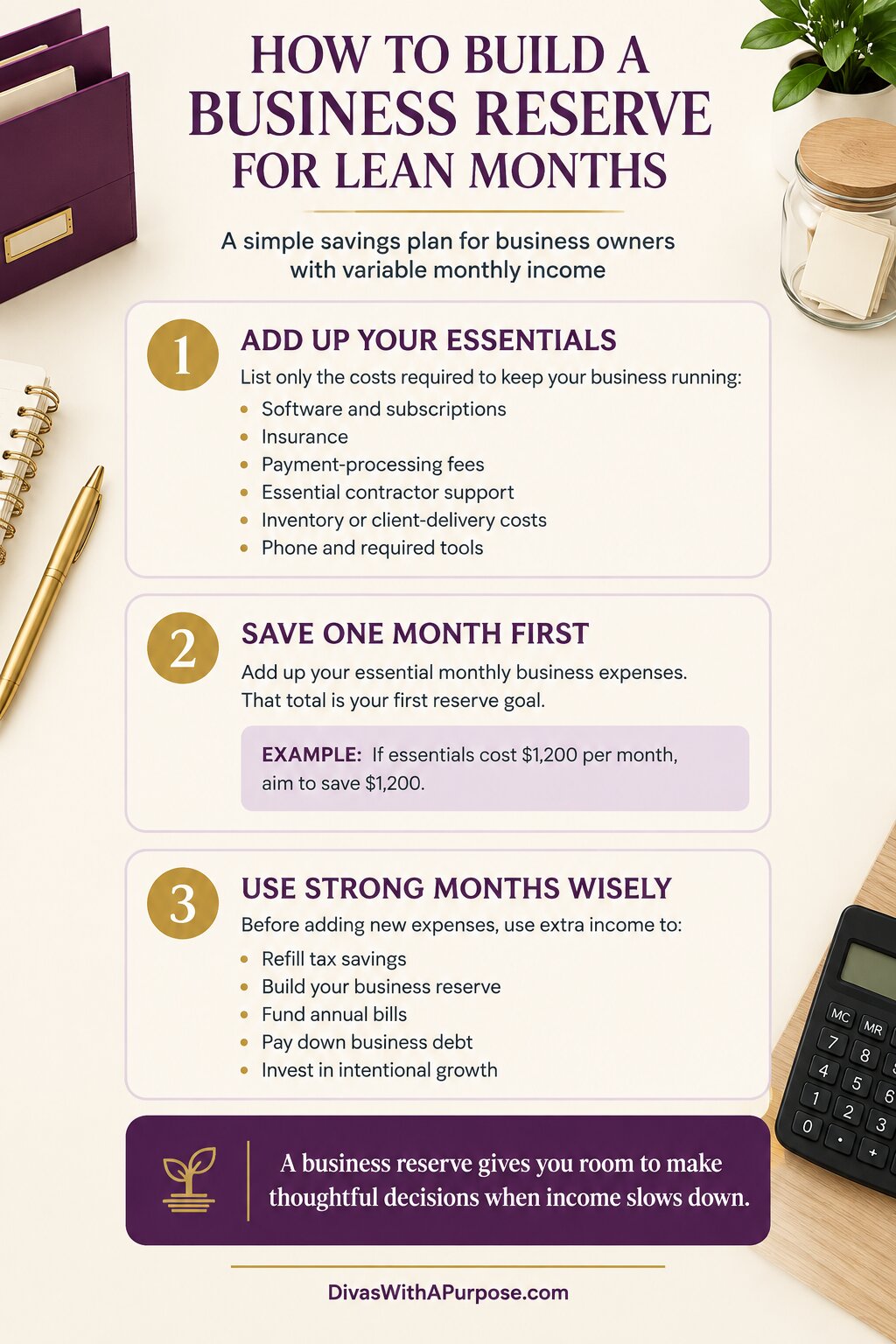
Begin with one month of essentials
Start by adding up only the business costs needed to keep serving clients. Think software, insurance, inventory for paid orders, payment tools, phone service, required subscriptions, and essential contractor support.
If your essential business expenses are $1,200 a month, your first reserve goal is $1,200. That first month of coverage matters.
Once you reach it, build toward three months or more based on your real risks. You may need extra coverage if one client provides most of your income, your work is seasonal, or your business depends on expensive equipment.
Let high-income months do future work
A strong month is not permission to raise every expense. Before adding a subscription, upgrading equipment, or increasing personal spending, ask what the extra income needs to protect.
Split surplus money between taxes, reserves, planned annual costs, debt repayment, and growth. You worked hard for that payment. Give it a purpose that supports you later.
A well-funded reserve creates more decision-making room and strengthens your financial security when income drops.
Adjust Spending Without Panic
One slow month does not mean your business is failing. It means your numbers are asking for your attention.
A simple weekly check-in helps you respond before bills pile up or stress takes over. Treat it as a repeatable money management habit.
Review cash flow every week
Set aside 15 minutes on the same day each week. Check your bank balance, payments received, unpaid invoices, bills due soon, and reserve balance.
Your cash-flow review should also include what is moving through the business. Operating activity includes money collected and paid for daily business needs. Investing activity includes purchases such as equipment. Financing activity includes loan payments and other borrowed money.
A weekly business financial audit can help you spot patterns early.
Make low-month decisions early
When income is below your baseline, pause nonessential expenses first and review your spending plan. Delay a nonessential purchase, follow up on invoices, reduce extra owner draws, and focus on sales activity that can bring in cash.
When income is above baseline, do not rush to spend the difference. Refill the categories that protect your next slow season.
Ask yourself: Which offer brought the strongest profit? Which expense changed most? What can I stop, adjust, or repeat next month?
Frequently Asked Questions
How much should I pay myself when income changes?
Pay yourself a planned amount that fits your conservative baseline, not whatever happens to be in the account that day. Set owner pay around your household priorities and financial goals.
During high-income months, build the buffer that helps you keep owner pay steadier later.
If the business cannot support your target draw yet, lower it temporarily and protect essential household costs first.
What if unpaid invoices keep growing?
Don’t build your spending plan around invoices that haven’t been paid. Follow up consistently, review your payment terms, and consider deposits or shorter due dates for future work.
Late-paying clients are a cash-flow issue. They may require stronger boundaries, not simply more hustle.
Do I need accounting software to use this system?
No. A spreadsheet can support this budgeting method when your transactions are manageable. It can work well for independent contractors and gig workers who update it regularly.
As your business grows, tools such as QuickBooks, Wave, or a bookkeeper may save time.
The IRS small business tax guide can also help you understand federal tax basics for self-employed work. Keep receipts, invoices, mileage records, and notes about the business purpose of shared expenses.
Give Your Income a Clear Direction
Your income may change each month, but your decisions do not have to change with every deposit. A conservative baseline, separate accounts, planned tax savings, and a growing reserve create greater financial security.
You are not behind because your business has uneven months. Keep looking at the numbers, make one clear adjustment at a time, and let each deposit support the business and life you are building.