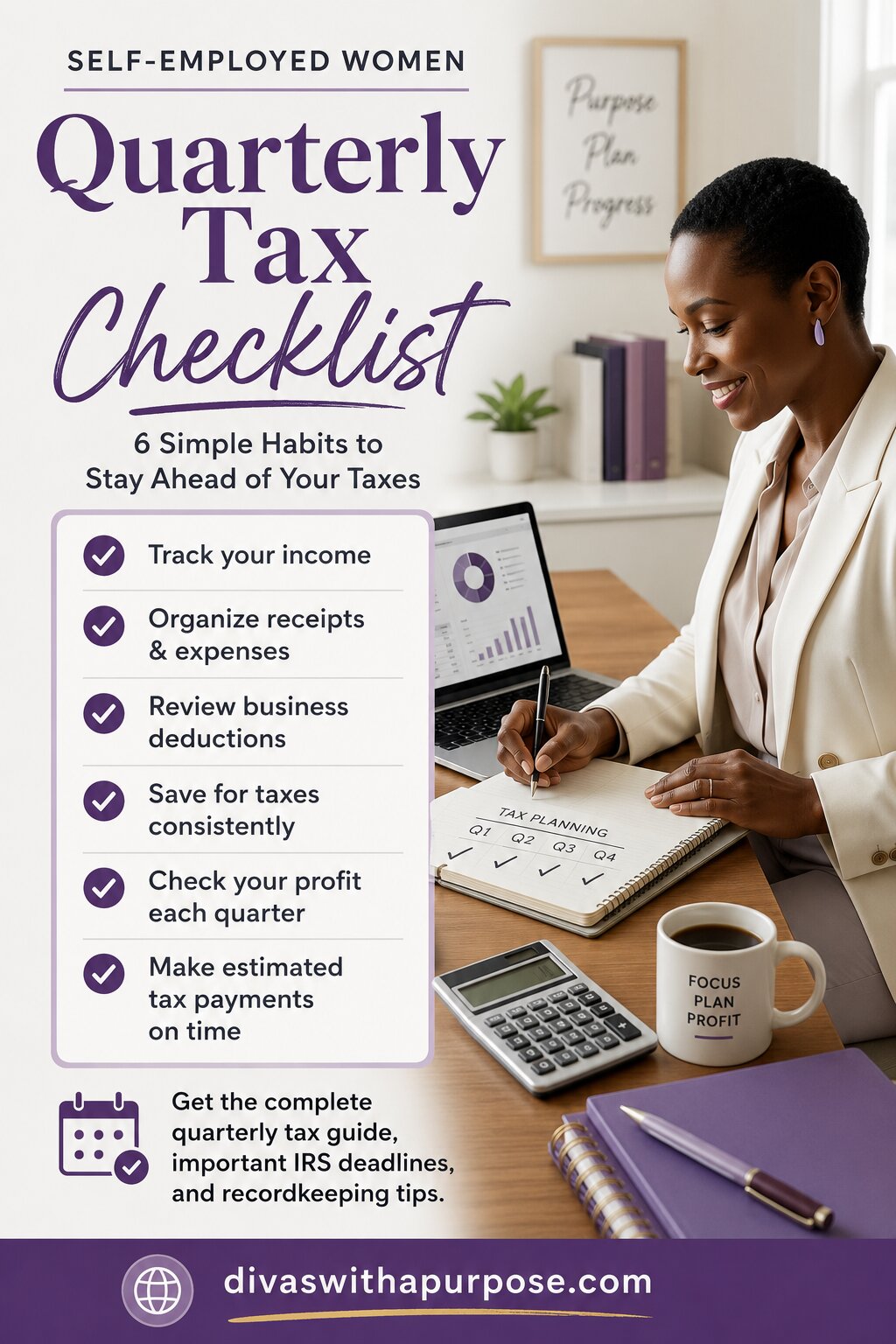
Quarterly Tax Checklist for Self-Employed Women

A late tax payment can feel like a surprise bill, even when you worked hard for every dollar. Your quarterly tax checklist gives your business a simple rhythm to manage small business taxes effectively: track what came in, track what went out, set money aside, and pay on time.
You do not need to be a tax expert to build good habits. You need a system that fits your real life, your business, and the many hats you already wear, supported by smart tax planning strategies.
Key Takeaways
- Making regular estimated tax payments covers both federal income tax and self-employment tax when you do not have enough tax withheld elsewhere.
- Put aside tax money as income arrives, not when a deadline is staring you down.
- Maintain a reliable tax preparation checklist by keeping receipts, mileage records, invoices, and bank statements organized every month.
- Review deductible expenses every quarter so you do not miss legitimate business costs.
- Because business tax deadlines and rules can change, always confirm dates and requirements with current IRS guidance.
Start With This Quarterly Tax Checklist
The IRS generally expects self-employed people to pay estimated taxes throughout the year when they expect to owe at least $1,000 in federal tax after withholding and credits. That can include freelancers, consultants, independent contractors, side-hustlers, and business owners who earn self-employment income.
Estimated tax payments are not always tied to neat three-month quarters. The second payment period is shorter, which is why a calendar reminder matters. Review the IRS estimated tax payment schedule before every payment season.
Here are the 2026 business tax deadlines to place on your calendar:
| Payment period | Estimated-tax due date |
|---|---|
| January 1 through March 31 | April 15, 2026 |
| April 1 through May 31 | June 15, 2026 |
| June 1 through August 31 | September 15, 2026 |
| September 1 through December 31 | January 15, 2027 |
Put each date in your paper planner and your phone calendar as part of your quarterly tax planning. Set one reminder two weeks ahead and another three days ahead. You deserve more than a last-minute scramble.

First Quarter: Build Your Tax Foundation
January through March is the time to get honest about your business numbers through quarterly tax planning. Pull together self-employment income from invoices, payment processors, cash payments, affiliate income, client retainers, a form 1099-NEC, and any other work connected to your business.
Start with a separate business checking account if you do not already use one. It is easier to see your real income and expenses when personal coffee runs are not mixed in with client payments.
Look at your prior-year income tax return, especially if this is not your first year in business. Your previous tax bill can give you a starting point for this year’s estimated payments. The IRS self-employed tax center is also a helpful place to confirm the forms and responsibilities that apply to you.
Before the April deadline, take these actions:
- Total your first-quarter business income and expenses.
- Transfer a percentage of income to a separate tax savings account.
- Estimate your profit, not only your revenue.
- Make your first federal income tax payment by April 15.
- Check whether state tax compliance also requires estimated tax payments.
Your tax savings percentage will depend on your income, deductions, household income, and state. Many self-employed women begin by setting aside 25% to 30% of profit, then adjust with a tax professional’s guidance.
Revenue is the money your business receives. Profit is what remains after legitimate business expenses. Taxes are based on more than the number sitting in your payment app.
Second Quarter: Clean Up Expenses Before June
The June deadline comes quickly. This is where many business owners get tripped up because April and May can be busy months filled with client work, school events, travel, and everyday life.
Do not wait until June to sort receipts. Spend one hour each month categorizing transactions in your bookkeeping software, spreadsheet, or expense tracker as part of your bookkeeping cleanup. QuickBooks, Wave, and a simple spreadsheet can all work when you use them consistently, and this habit makes your overall tax preparation checklist much easier to manage.
Review the expenses that support your business, keeping an eye out for valuable tax deduction sources. Common deductions may include business software, website hosting, professional fees, advertising, office supplies, education related to your work, and business-use mileage. The expense must be ordinary and necessary for your business, and you need records to support it.
Pay attention to self-employment tax, too. Unlike a traditional job where your employer handles federal income tax and reports your wages on a form W-2, you are responsible for covering Social Security and Medicare on your own. The rate is commonly 15.3% on net self-employment earnings, though limits and other tax rules may apply.
By June 15, make your second estimated tax payments. Use the IRS estimated tax guidance to review calculations, payment options, and Form 1040-ES details.

Third Quarter: Check Your Profit, Not Your Guess
Summer can bring a slower season, a busier season, or a little of both. Do not base your September payment on what you hoped to earn. Base it on your actual year-to-date numbers as part of your ongoing quarterly tax planning.
Run a profit and loss report through August 31. If you use a spreadsheet, list every source of income, total your expenses by category, and calculate the difference. Compare that number with your initial financial projection from January.
If revenue increased, raise your tax savings amount now. If your self-employment income dropped, your payment may need to change. Estimated payments do not have to be identical when your income is uneven.
This is also a smart time to review your mileage log. Record the date, destination, business purpose, and miles for each business trip. A calendar appointment alone is not enough to prove the business purpose.
Submit your estimated tax payments by September 15. Then take a breath. You are not behind. You are building a business that knows where its money is going.
Fourth Quarter: Plan Before the Year Closes
The fourth quarter is where effective quarterly tax planning and strong tax planning strategies can protect both your peace and your cash flow. Do a year-end estimate in October or November, not on December 31.
Gather your year-to-date income, expenses, estimated payments already made, and projected December income. Then ask a simple question: Will I likely owe more than I have saved?
If the answer is yes, make adjustments while you still have time. You may decide to increase your final estimated payment, reduce discretionary spending, or talk with a CPA about your options.
Retirement contributions may also lower taxable income when you qualify. A SEP IRA or an individual 401(k), often called a solo 401(k), paired with a thorough retirement plan review, can be worth exploring for self-employed women with net business profit. Contribution limits, eligibility, and deadlines vary, so get clear guidance before moving money.
Make your fourth estimated payment for federal income tax by January 15, 2027. You may have different options if you file your income tax return and pay the full balance early, but confirm the current rule before relying on it.
Keep Records That Make Tax Time Easier
Good records are not about perfection. They are about giving yourself proof when you need it. By following a reliable tax documents checklist, you can keep everything organized. Save digital copies of receipts and back them up in a cloud folder. Label files by month and expense category so you can find them later.
Keep these records for your business:
- Income records, invoices, form 1099-NEC, form W-2, sales reports, and payment processor statements to support your income tax return.
- Expense receipts, bank statements, credit-card statements, and bills.
- Mileage logs and documentation for business travel.
- Records for equipment purchases, furniture, and other larger items.
- Proof of quarterly tax payments and retirement contributions.
A home-office deduction can be available when part of your home is used regularly and exclusively for business. Health insurance marketplace options, vehicle costs, and charitable donations can also have special rules. Do not claim something because you heard it in a social media post. Claim it because you can document it and it fits the tax rules.
When It Is Time to Call a CPA
A CPA, enrolled agent, professional tax preparer, or qualified tax professional can bring welcome clarity when your finances become more complicated. Reach out when you have multiple income streams, hired contractors, formed an LLC or made an S-Corp election, moved states, sold business property, or received an IRS notice.
You may also want support if your income changes sharply during the year. A professional can help you estimate payments based on your actual profit, file a timely business return extension, track your personal identification number, navigate the tax refund process, or prepare an accurate income tax return.
This article is for educational purposes only and is not personalized tax, legal, or financial advice. Verify current IRS rules and deadlines, and consult a qualified professional about your circumstances.
Frequently Asked Questions
What happens if I miss a quarterly estimated tax deadline?
Missing a quarterly tax deadline can result in underpayment penalties and interest charges from the IRS. However, you can minimize these penalties by catching up on your payments as soon as possible or by consulting a tax professional to discuss your options.
Do I need to pay quarterly taxes if my self-employment income is low?
The IRS generally requires estimated tax payments if you expect to owe at least $1,000 in federal tax after withholding and credits. If your income is very low and you do not meet this threshold, you may not need to make quarterly payments, but reviewing your specific numbers each quarter is always wise.
How much money should I set aside for my quarterly taxes?
Many self-employed women start by saving between 25% and 30% of their net business profit for taxes. Your exact percentage will depend on your total income, deductions, household income, and state tax requirements.
Can I deduct personal expenses on my quarterly business taxes?
No, you can only deduct ordinary and necessary expenses that directly support your business operations. Mixing personal expenses, such as everyday groceries or personal travel, with your business deductions can trigger issues during tax preparation.
A Quarterly Habit That Supports Your Goals
Taxes are part of owning your purpose, not a punishment for earning more. When you track your money, save intentionally, and pay attention each quarter, you give your business room to grow without fear following close behind, making it much easier to manage small business taxes year round.
Your quarterly tax checklist does not need to be complicated. It needs to be consistent, honest, and strong enough to support the woman and business you are becoming as you stay on top of your federal income tax obligations.