
Align Your Calendar With Your Values

Your calendar tells the truth, even when your goals sound beautiful on paper. If you keep saying family, health, peace, faith, or growth matter, but your week never makes room for them, you are missing out on the core principles of intentional living.
That does not mean you are lazy or failing. It usually means life got loud, work got first pick, and your own priorities got pushed to the edge. Real calendar values alignment starts with honest reflection, then a few clear changes you can keep for better aligning your days.
Key Takeaways
- Your calendar shows your lived priorities better than your intentions do.
- Identify 3 to 5 core values before you try to rebuild your week.
- Audit the last two weeks first, because guesses usually miss the real problem.
- Prioritize value-based time blocks on the calendar before smaller tasks fill the space to significantly improve your time management.
- Review your week often, and protect it with simple boundaries.

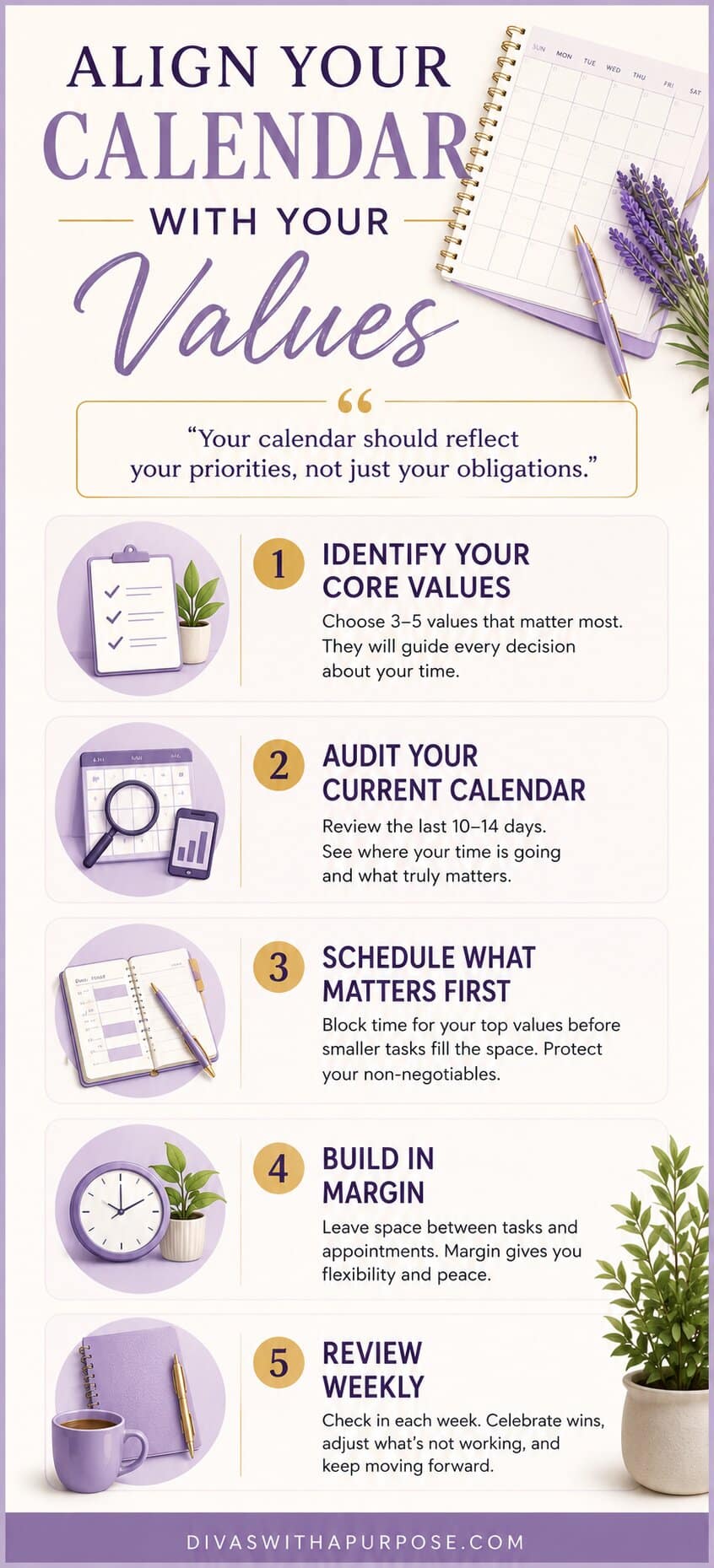
Identifying Core Values and the Week You Want
Before you move one meeting or color-code one block, get clear on what matters most. Values are not just nice words for a journal page. They are the value system that shapes your choices.
If that feels harder than it should, you are not alone. Many busy adults can list responsibilities in seconds, but freeze when asked what they want their time to stand for.
Start small. Ask yourself which moments made you feel most like yourself in the last month. Think about what you protect without resentment. Notice what keeps bothering you when it gets neglected.
You don’t need a list of 20 values. You need a short list of core values that can guide a real week. For most people, 3 to 5 is enough. That list might include family connection, health, financial stability, creativity, faith, service, learning, rest, or community.
Don’t pick values that sound impressive. Pick values that feel true and align with your life purpose. Peace counts. Stability counts. Freedom counts. Your values do not need fancy wording to matter.
If you want help putting language to what matters, the University of Liverpool’s values reflection guide is a useful place to start. It keeps the process simple and grounded.
If you can’t name your values, your calendar will keep getting built by urgency.
Write your top values somewhere you can see them during weekly planning. Whether it is on a sticky note, in your planner, or in a notes app, keep them visible to ensure proper decision making alignment. The point is to stop planning from pressure alone.

Audit your current calendar before you fix it
Most people try to build a better week without looking at the one they already lived. That is like cleaning a closet in the dark. You might move things around, but you will not see what is taking up space.
Look back at the last 10 to 14 days. Check your calendar, email timestamps, call logs, text history, and screen time reports on your phone. If you use Google Calendar or Outlook, scan for patterns. If you keep a paper planner, look for crowded days, empty promises, and repeated reschedules.
Look for patterns instead of perfection
Now ask better questions. Where did your hours actually go? Which activities matched your values? Which ones kept stealing time without giving much back? As you evaluate your time investment, look for patterns that reveal where you are truly focusing your energy.
You will usually find three kinds of time use. Some blocks support your life and goals. Others are necessary but draining. Still others represent pure drift, including mindless scrolling, unnecessary errands, and meetings that should have been emails. Comparing these intentions vs investments helps you identify exactly where your schedule is leaking energy.
Notice what is missing
This is also the moment to notice what never made it onto the calendar at all. Exercise may keep living in your head instead of finding a place on your calendar. Date night might be important, yet it never actually gets scheduled. Prayer, journaling, budgeting, or focused work often ends up with whatever crumbs of time are left.
Don’t judge the audit too fast. You are gathering data, not building a case against yourself. The goal is clarity.
If you are surprised by how much work spills into every corner, that is common. It can even take a toll on your mental health when you feel like everyone else’s needs got a reservation before yours did. Seeing the gap between your values and your schedule is uncomfortable, but it is also the turning point that allows you to finally restructure your life to reflect your priorities.

Turn your values into calendar decisions
Once your values are clear and your audit is honest, it is time to turn both into action. This is where good intentions stop floating and start getting appointments.
Turn values into scheduled time
Begin with one simple question for each value: “What would this look like on a calendar?” A value means nothing if it stays abstract. Use the table below as a template for your daily plan to see how abstract values translate into scheduled time.
| Value | What it can look like in a real week |
|---|---|
| Health | Three 30-minute walks, lunch away from your desk, bedtime alarm |
| Family connection | Protected dinner times, school events blocked early, Saturday morning together |
| Financial stability | Weekly budget review, client follow-up block, invoice day |
| Growth | One learning block, one networking call, one focused project session |
| Rest | No-work window, one slower evening, recovery time after busy days |
Notice what changed there. These are not vague promises; they are calendar items.
Start by placing your non-negotiable value blocks first to protect your time. Family time might mean blocking dinner or school pickup before small meetings begin filling your calendar. Good health becomes more likely when you schedule a walk just like you would a doctor’s appointment. Financial stability can start with a recurring money check-in every Friday.
Protect your highest priorities first
Next, give your highest-value work a home. A focused 60-minute block, like the Hour of Power method, is a strong way to ensure progress when your day is full. This approach creates a productive balance because one hour of real attention beats three scattered hours every time.
Then build in margin. Leave transition time between meetings, add travel time, and protect buffer space after demanding work or caregiving. Managing energy is just as important as managing tasks, and having built-in recovery time is essential for long-term work-life harmony. A values-based calendar is not packed tight; it is built to hold real life.
Start small and build consistency
Last, keep the first version small. You do not need a perfect new routine by Monday. Pick one or two value blocks and repeat them weekly. Consistency matters more than ambition here.
A few real-life examples make this easier. For someone who values connection, blocking phone-free dinners three nights a week can make a meaningful difference. Those who prioritize excellence at work might protect two morning focus sessions before opening email. If rest is one of your core values, consider setting a hard stop at 8:30 p.m. and leaving one weekend morning completely unscheduled.
This is what calendar values alignment looks like in practice. Not a pretty planner and not a full life makeover. It is just time that starts telling the same story your heart has been trying to tell.

Common mistakes that pull your schedule off course
One common mistake is picking too many values. If everything matters equally, your calendar will not know what to protect first. Keep your list short enough to use when real choices show up.
Another mistake is scheduling your ideal self instead of your actual life. It is easy to plan 5 a.m. workouts, two hours of deep work, family dinner, reading time, and a spotless house. It is harder to live that after meetings, traffic, caregiving, and plain old fatigue. You must manage the tension between urgency vs intentionality by building a schedule for the season you are in.
Work also has a way of taking every open inch unless you stop it. That is why boundaries matter. A simple Not Right Now list can help you capture good ideas without letting them crowd out today’s priorities.
Then there is the mistake of leaving no breathing room. Back-to-back scheduling looks efficient until one delay wrecks the whole day. Buffers protect your peace and support your overall wellness and well-being. They also make it easier to keep promises to yourself.
Finally, do not set your calendar once and disappear from it. Your week needs regular attention. A brief calendar review of ten minutes on Sunday or Monday can help you check what fit, what slipped, and what needs to change. If you want another practical perspective on aligning time management with your values, keep it nearby during that review.
Small corrections count. A values-based calendar is not rigid. It is responsive, honest, and built on what matters most right now, ensuring that your schedule alignment stays true to your priorities.
Frequently Asked Questions
How many values should I prioritize in my calendar?
You should aim for 3 to 5 core values to keep your schedule focused and manageable. Selecting too many can lead to decision fatigue and make it impossible to protect enough time for what truly matters.
Why is it important to audit my calendar before setting new goals?
An audit reveals the gap between your stated intentions and how you actually spend your time. It helps you identify where your energy is leaking and highlights which tasks are stealing space from your true priorities.
What if I struggle to keep the value blocks I have scheduled?
Start small by choosing only one or two non-negotiable blocks to protect each week rather than overhauling your entire routine. If you miss a block, simply adjust your expectations and aim for consistency in the following week instead of aiming for perfection.
Conclusion
Your calendar already tells a story. The good news is that story can change, one block at a time.
You do not need a brand-new life to create better alignment. You need a short list of values, an honest look at your current week, and the courage to commit to living in alignment by reserving time for what matters before everything else claims it.
Pick one value today. Give it one real place on next week’s calendar, and let that be the start. Reserving time for your personal priorities is the first step toward a meaningful change.