
Preventative Home Repairs: How Timely Fixture Maintenance Saves Money Long-Term
Image credit Unsplash
That mysterious “drip, drip, drip” from the kitchen faucet. The squeak in the floorboard you’ve learned to step over. That garage door that groans a little louder each time it opens. We all have these tiny home annoyances we promise to get to “one day.” But what if that “one day” is the difference between a five-dollar fix and a five-thousand-dollar disaster?
Taking care of your home proactively isn’t just about keeping things tidy; it’s a smart financial move that protects your biggest investment and saves you money and stress later. Fixing small issues quickly, like a leaky faucet or a slow drain, can stop them from turning into costly emergencies that require a plumber.
Putting off small repairs might feel harmless, but it’s often the first step toward a much bigger, more expensive problem. By tackling issues when they’re minor, you stop the chain reaction before it even starts, keeping your home safe and your budget happy.
The High Cost of Procrastination
Ignoring a small issue in your home is kind of like letting a tiny crack in a dam go unchecked. At first, it’s nothing. But over time, pressure and wear turn that tiny flaw into a huge failure. A slow leak under a sink might seem like just a small annoyance, but if you leave it alone, it can lead to rotten wood in your cabinets, warped flooring, and even mold, which is super expensive to get rid of. That rattling sound in your air conditioner could be a loose part that a technician can tighten in minutes. Ignore it, and you could end up with a completely burned-out compressor and need a whole new system right in the middle of a heatwave.
The basic idea is simple: emergency repairs always cost more than planned maintenance. When a pipe bursts or an appliance completely breaks down, you’re forced to pay for immediate service, often at a higher price. You won’t have time to shop around for quotes or wait for a sale on a replacement part. Studies consistently show that preventative maintenance saves money because it lets you control when and how much you spend on repairs. A scheduled tune-up for your furnace costs way less than what you’d pay for an emergency call on the coldest night of the year.
Big Systems That Demand Attention
While every part of your home could use some love, a few major systems are critical to how your house works and can lead to the biggest bills if you ignore them. Think of your HVAC (heating, ventilation, and air conditioning), plumbing, and electrical systems as the heart, veins, and nervous system of your house. Checking them regularly isn’t optional. For your HVAC, that means changing filters every 1-3 months and having a pro service it once a year. For plumbing, that means regularly checking for leaks under sinks and around toilets, and knowing where your main water shut-off valve is.
Another big system you use daily but easily forget is your garage door. It’s the largest moving thing in most homes, with a complicated mix of springs, cables, rollers, and an opener motor. A garage door that shudders, makes grinding noises, or seems off-balance isn’t something to ignore. These are often early signs that a part is failing. Catching it early with professional garage door repair can mean a simple adjustment or a small part replacement. Waiting until a spring snaps or the door comes off its tracks can leave you with a completely unusable door, a damaged car, or even a serious safety risk. Adding these major systems to a proactive home maintenance schedule is key to avoiding surprise breakdowns that empty your savings.
Creating Your Own Maintenance Checklist
The thought of maintaining an entire house can feel overwhelming, but you don’t have to do everything at once. The secret is to break it down into a manageable schedule. Creating a seasonal or monthly checklist turns a huge chore into a series of small, doable tasks. A great way to do this is to link tasks to the changing seasons, since the weather often tells you what needs attention.
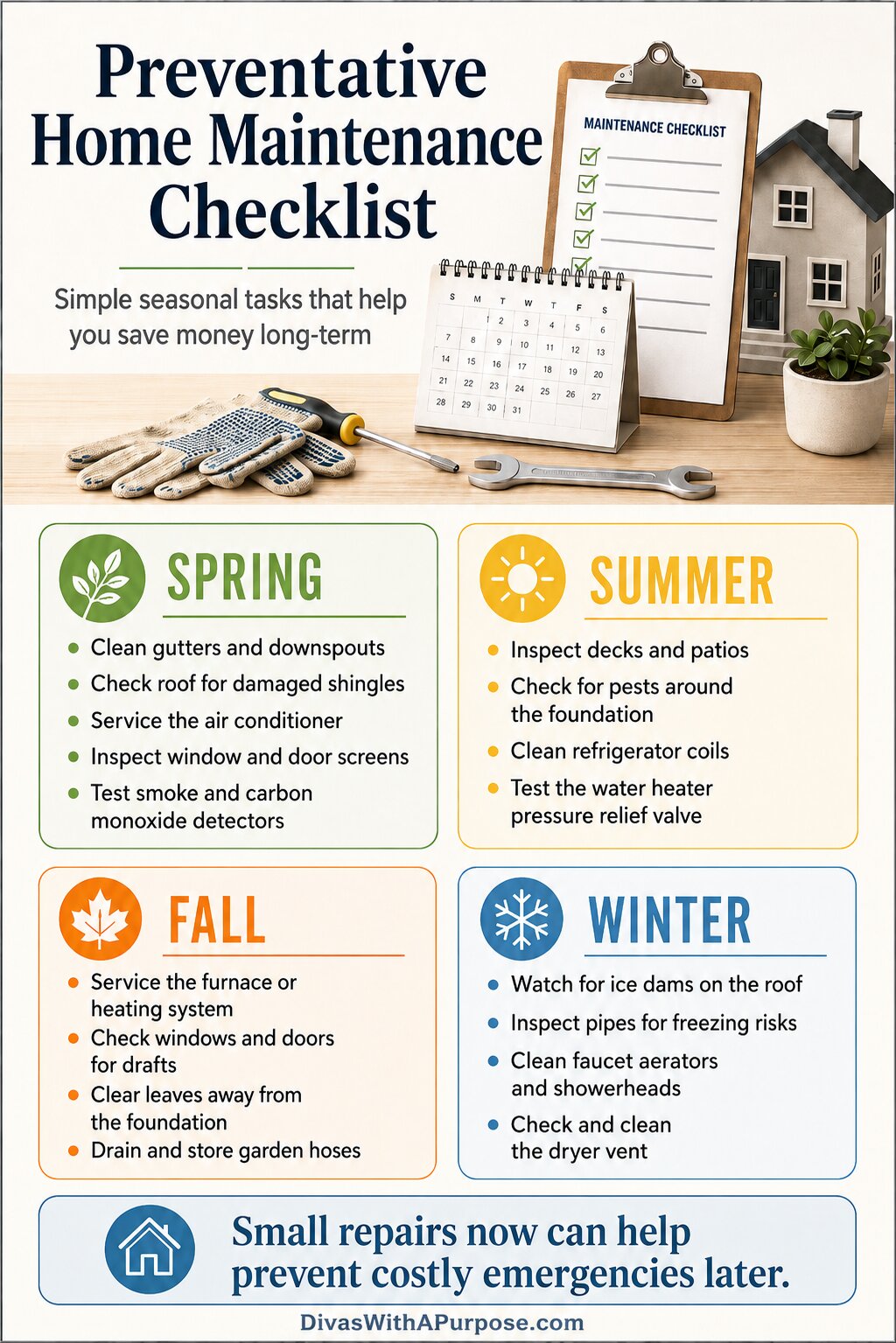
Here’s a sample seasonal breakdown to get you started:
Spring (March – May)
- Clean out gutters and downspouts from winter gunk.
- Check the roof for any damaged or missing shingles.
- Get your air conditioning system serviced before summer heat hits.
- Look at window and door screens for tears.
- Test smoke and carbon monoxide detectors, and change batteries if needed.
Summer (June – August)
- Check decks and patios for loose boards or fading sealant.
- Look for pests around the foundation.
- Clean the coils on the back of your refrigerator to make it run better.
- Test the pressure relief valve on your water heater.
Fall (September – November)
- Have your furnace or heating system inspected and serviced.
- Check windows and doors for drafts and add weatherstripping.
- Rake leaves away from the foundation and AC unit.
- Drain and store garden hoses.
Winter (December – February)
- Check for ice dams on the roof after heavy snowfall.
- Inspect pipes in unheated areas like basements or crawl spaces for freezing risks.
- Clean faucet aerators and showerheads to remove mineral buildup.
- Check and clean your dryer vent to prevent fire hazards.
This is just a starting point. You can find detailed guides for preventative home maintenance online and customize your list to fit what your home specifically needs.
The Small Fixes That Make a Big Difference
While big systems get a lot of attention, it’s often the little, forgotten fixes that can wear down your home and lead to bigger problems. These weekend tasks take less than an hour but give you huge returns on your time. For example, spending 20 minutes re-caulking the seam around your bathtub can stop water from seeping into the wall, which could otherwise cause hidden mold and wood rot that costs thousands to fix.
Think about the things you use every day. A wobbly toilet can eventually damage the wax ring at its base, leading to a slow, silent leak that ruins the subfloor. A dripping faucet not only wastes hundreds of gallons of water over a year but also wears out the fixture itself. Tightening loose cabinet hinges, replacing worn-out weatherstripping around a door, or cleaning the lint from your dryer’s exhaust duct are all simple actions with big payoffs.
These tasks do more than just save money; they make your life better. All these small fixes add up to the benefits of preventive home maintenance like better energy efficiency, cleaner indoor air, and a safer home. Taking care of these little things gives you a sense of control and pride in your home.
Knowing When to DIY vs. Call a Pro
One of the most important parts of home maintenance is knowing your limits. DIY tutorials have made many homeowners feel confident enough to tackle repairs themselves, which can be a great way to save money. Tasks like changing a faucet washer, patching a small hole in drywall, or painting a room are excellent DIY projects for beginners. These jobs usually need basic tools and don’t have a high risk of causing more damage if you mess up.
However, some jobs are definitely best left to licensed and insured professionals. This includes most electrical work, major plumbing repairs, and anything involving gas lines. The risk of fire, flood, or personal injury is too high. Similarly, while you can lubricate the moving parts of your garage door, replacing the high-tension springs is extremely dangerous and should always be handled by a trained technician. A good rule of thumb is to think about what could go wrong if you botch a repair. If a mistake could lead to a fire, a flood, or serious injury, it’s time to call a pro. Paying a professional for an hour of their time is much cheaper than paying for a hospital visit or a major home restoration project.
Start small, build your confidence, and never be afraid to ask for help when a job is beyond your skill set. Your home and your safety are worth it.
This weekend, instead of walking past that squeaky hinge or ignoring that slow drain, take a few minutes to address it. Each small fix is a step toward a healthier, more secure home and a healthier bank account. You’re not just fixing a problem; you’re investing in your future.