
Investing $100 Per Month: A Confident Way to Begin

A hundred dollars may not feel like much when bills, groceries, family needs, and everyday life are calling your name. But investing $100 per month is a meaningful way to build financial habits that can support your future goals and long-term wealth building.
You don’t need to wait until your income doubles or your budget looks perfect. You need a clear plan, a place for your money to grow, and the consistency to keep showing up.
Key Takeaways
- Start with a solid foundation, including emergency cash stored in a high-yield savings account and a plan for high-interest debt.
- Choose an account based on your goal, timeline, and any employer match options offered through retirement accounts.
- Keep your investments simple with diversified, low-cost index funds or ETFs.
- Automate your $100 contribution so making small monthly deposits happens consistently without relying on memory or motivation.
- Growth takes time, and investment returns are never guaranteed.
Build Your Foundation Before You Invest
Before you begin putting money into the market, take an honest look at your financial foundation through proper financial planning. Investing is exciting, but it shouldn’t leave you stressed when life happens.
Start with an emergency fund. Even a small cash cushion can help when the car needs repairs, a child gets sick, or an unexpected bill shows up. Money for emergencies belongs in a savings account where you can reach it easily, not in investments that may be down when you need to withdraw it.
Next, look closely at high-interest debt. Credit card balances with double-digit interest rates can eat up your progress fast. Paying down that debt may give you a stronger return than investing because you’re no longer losing money to expensive interest charges.
Investing money you may need within a few years can force you to sell during a market downturn.
Give yourself permission to begin small here, too. Maybe your first few months of that $100 go toward an initial investment in your emergency fund or debt payoff. That doesn’t mean you’re behind. It means you’re creating room to invest with more confidence later.
Think about your goal as well. Are you investing for retirement 25 years from now? A home down payment in five years? More freedom in your 50s? Your long term goals matter because shorter-term needs usually require safer places for your money.

How to Start Investing $100 Per Month With Purpose
When you are ready, give every dollar a job. Investing $100 per month works best when it is connected to a goal that matters to you.
Write down what you are building toward. It could be retirement, a future career change, a child’s education, or the ability to make choices without every decision coming down to money. A clear goal gives your monthly contribution meaning when you are tempted to skip it.
Then decide how much risk makes sense for your timeline as part of your broader investment strategy. Investments that include stocks can rise and fall sharply in the short term. They have historically offered more potential for long-term growth than cash, but there are no promises. The S&P 500, a common measure of large U.S. companies in the stock market, has produced historical market returns near 10% on average before inflation, though individual years can look very different. Fidelity’s overview of historical S&P 500 returns is a helpful reminder that past averages are not a forecast.
For a goal that is decades away, you may be able to handle more ups and downs. For money you plan to use soon, protecting the balance matters more than chasing growth.
A simple question can help: “If this money dropped in value next month, would I still be able to leave it alone?” If the answer is no, the money may not belong in stock investments yet.
Choose the Right Account for Your Goal
The account you choose matters almost as much as what you invest in. You do not need every account. You need the one that fits your next step.
If your employer offers a retirement plan, such as a 401(k), 403(b), or similar workplace plan, start there. Many employers offer a matching contribution when you save a portion of your paycheck. That match is part of your compensation, so make sure you understand the rules and contribution amount needed to receive it.
Tax-advantaged retirement accounts are a strong core option for long-term growth. An Individual Retirement Account, commonly called an IRA, is another retirement option. A traditional IRA may offer a tax break now, depending on your income and situation. A Roth IRA is funded with money you have already paid taxes on, and qualified withdrawals in retirement are generally tax-free. Read the current rules carefully before opening either one.
Taxable brokerage accounts can work well for goals outside retirement. There are no retirement withdrawal rules, but you may owe taxes on dividends, interest, or investment gains. This flexibility can be useful when you want access to your money before retirement age. To keep your costs down, look for low fee platforms that feature a beginner friendly layout and transparent pricing.
For a helpful overview of getting started with a modest amount, State Street Global Advisors shares a beginner’s guide to investing with $100.
Don’t choose an account because it sounds impressive. Choose it because it supports your goal, your timeline, and your real life.

Keep Your Investments Simple and Diversified
You don’t need to hunt for the next hot stock to begin investing. In fact, buying one company’s stock can put too much pressure on one decision, making it difficult to build a strong investment portfolio.
A diversified fund spreads your money across many companies, and sometimes across different types of investments. Broad-market index funds and exchange traded funds, often called ETFs, are common beginner-friendly choices because they provide broad market exposure by holding hundreds or thousands of companies in one investment.
An index fund follows a market benchmark rather than relying on someone to pick individual winners. Vanguard’s explanation of how index funds work offers a clear look at the basic idea.
When working with a modest monthly budget, you can use fractional shares to purchase portions of higher-priced assets, helping you create a diversified portfolio without needing a large lump sum.
Also pay attention to fees. Every fund has an expense ratio, which is the annual cost charged to investors. A small percentage can look harmless, but fees take money from your returns year after year. Look for low-cost options and read the fund information before you buy.
You may also see target-date retirement funds. These funds are built around an expected retirement year and usually become more conservative as that date gets closer. They can be a simple option, but check the fees and holdings first.
Put Your $100 on Autopilot
Consistency is where the magic happens. It is not flashy, but it is powerful.
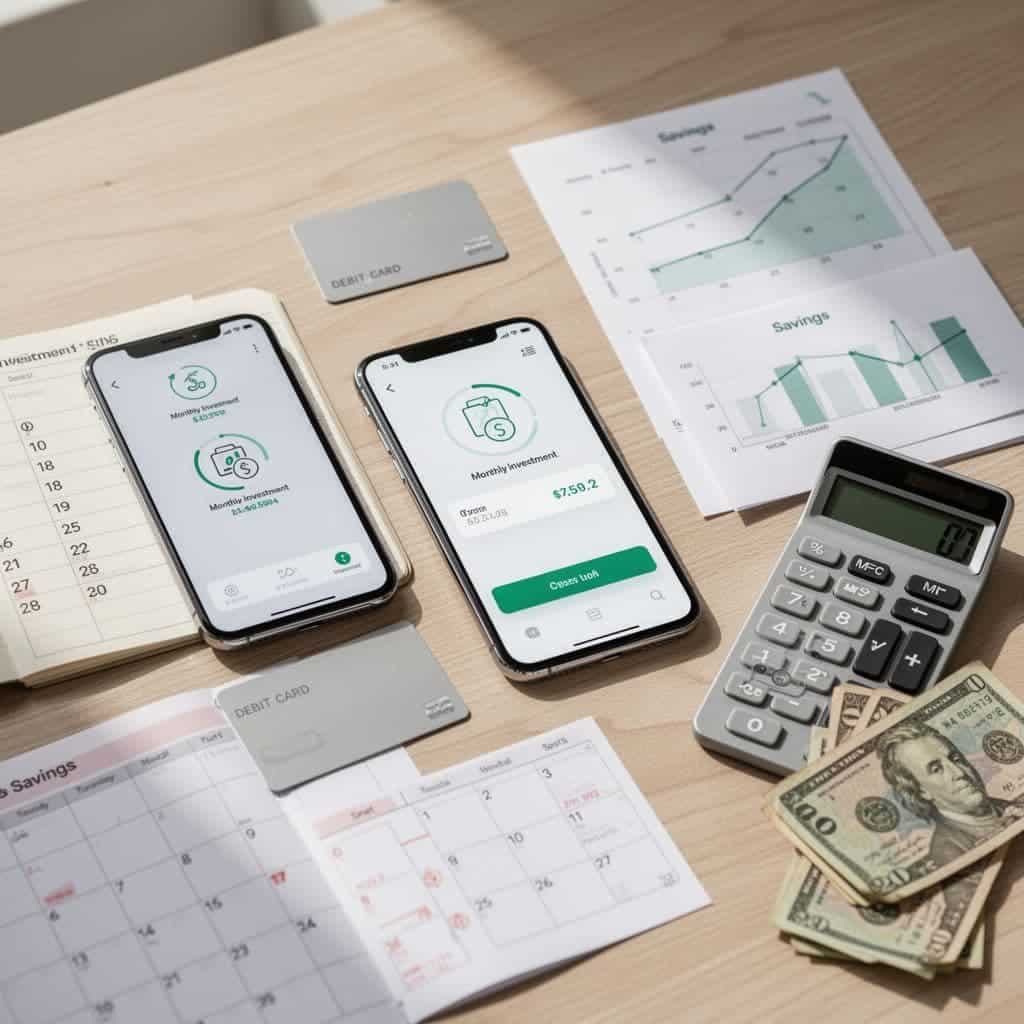
Set up an automatic transfer for the day after payday to establish automated investments. When this process becomes part of your regular routine, you are less likely to spend the money on things that will not matter next week.
You can split the amount if that fits your paycheck schedule better. For example, $50 from each twice-monthly paycheck gets you to the same $100 monthly total. The amount is not the point. The pattern is, and maintaining steady monthly contributions matters most.
Avoid checking your balance every day. Market movement can stir up fear, especially when prices fall. Review your investments a few times a year instead. Confirm that your contributions are arriving, your investments still match your goals, and your fees remain reasonable.
As your income grows, consider increasing the contribution by $10 or $25 at a time. Small raises to your savings rate can make a real difference without turning your budget upside down.
What $100 a Month Could Grow Into
Time gives regular contributions room to grow through the power of compound interest. The numbers below assume you invest $100 at the end of every month and earn an average 6% annual return, compounded monthly.
| Time Invested | Your Contributions | Estimated Value at 6% |
|---|---|---|
| 10 years | $12,000 | $16,400 |
| 20 years | $24,000 | $46,200 |
| 30 years | $36,000 | $100,500 |
After 30 years, you would have contributed $36,000. The rest of the estimated balance comes from potential investment growth over time, especially as compound interest accelerates your returns in the later decades.
These figures are examples, not guarantees. Markets do not deliver the same return every year. Your account balance will rise and fall, and inflation can reduce what your money buys. Still, setting your portfolio to automatically reinvest dividends and investing $100 per month gives compound growth a chance to work for you.
Frequently Asked Questions
Is $100 per month really enough to start investing?
Yes, starting with $100 per month is a fantastic way to build sustainable financial habits and get comfortable with the market. Over time, the power of compound growth and consistent contributions can turn these small amounts into a meaningful balance.
What type of investments should I buy with my $100?
Beginner investors often benefit from keeping things simple with broad-market index funds or exchange-traded funds (ETFs). These options provide instant diversification by holding shares in hundreds or thousands of companies at a low cost.
Should I pay off debt before I start investing?
It depends on the type of debt you hold, particularly high-interest credit card balances that eat away at your savings. Tackling expensive debt first often provides a guaranteed return, but you can also set aside a small emergency fund at the same time to protect your progress.
Final Thoughts
Starting with $100 is not too small. Committing to investing $100 per month is a decision to make room for your future, even while you are managing today’s responsibilities.
Build your foundation first, choose a simple diversified investment, and make your contribution automatic. Consistent progress can carry more weight than waiting for the perfect time to begin, and it serves as a reliable pathway toward long-term financial freedom.