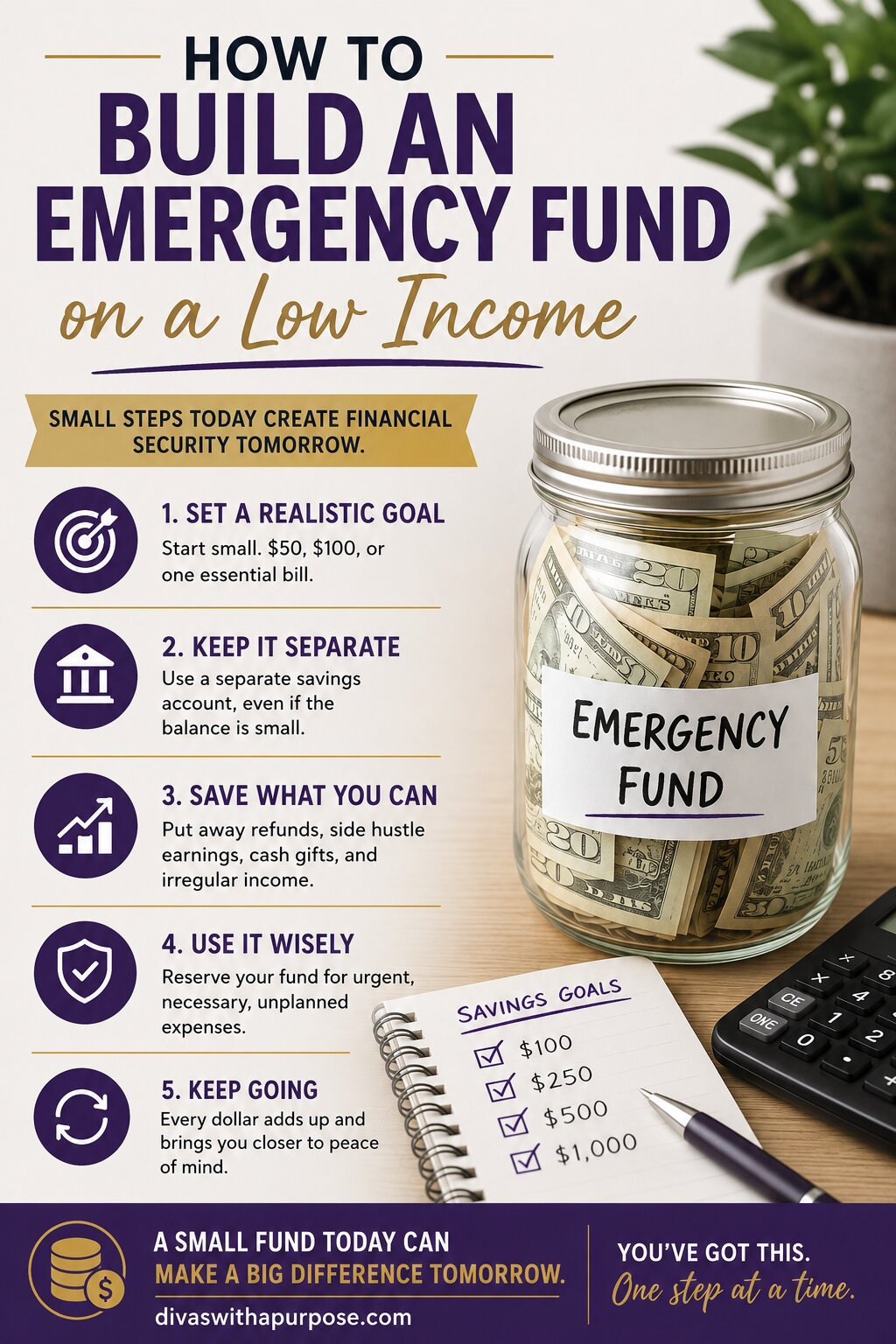
How to Build an Emergency Fund on a Low Income

An unexpected car repair or a sudden sick day can turn an already tight month upside down when you are dealing with unexpected expenses. For many people, the constant cycle of living paycheck to paycheck makes setting aside extra cash feel nearly impossible. However, building an emergency fund on a low income does not have to begin with hundreds of dollars.
Your first goal is not perfection. It is creating a little breathing room, one small deposit at a time, so the next surprise does not have to become new debt.
Key Takeaways
- Start with a small, personal goal, such as $100, $250, or one essential bill.
- Keep emergency savings in a separate savings account from your spending money, even if the balance is small.
- Save irregular income, refunds, cash gifts, and side-gig earnings with a simple plan.
- Use the fund for urgent, necessary, unplanned costs like car repairs or medical bills, rather than every expense that feels stressful.
- If money is too tight to save right now, protect essentials first and return to your emergency fund goal when your finances stabilize.
Start With a Goal That Fits Your Real Life
You do not need to aim for three months of expenses on day one. That number can feel heavy when rent, groceries, childcare, medication, or debt payments already take most of your paycheck.
Begin with a starter goal that feels possible. Maybe it is $50. Maybe it is $100 to cover a co-pay, a tire patch, or a utility bill that came in higher than expected. Then grow it to $250, $500, and eventually work toward your $1,000 goal, which provides a much stronger buffer for life’s surprises.
The Consumer Financial Protection Bureau’s emergency fund guide recommends setting a specific savings goal and building a system for regular contributions. A goal gives your money a name. It gives you a reason to protect it.
Here is one way small milestones can work:
| Savings milestone | What it may help cover |
|---|---|
| $100 | Prescription, co-pay, gas, small home need |
| $250 | Minor car repairs, utility shortage, urgent travel |
| $500 | Larger car repairs, medical bills, emergency childcare |
| $1,000 | A stronger cushion during a hard month |
Your number may look different, and that is okay. A family with a child who has medical needs may need a different target than someone with reliable public transportation and no car payment.
A small emergency fund is not “too small.” It is proof that you are building support for yourself.
If you are behind on rent, facing a shutoff notice, or choosing between food and medication, saving may need to wait. Call 211 to ask about local housing, food, government assistance, and utility assistance programs in your community. Taking care of today’s emergency is part of building financial stability too.
Give Your Emergency Savings Its Own Home
Saving is significantly easier when your emergency money is not sitting beside your everyday spending. Keeping these funds in a separate bank account helps create a necessary pause before you move money back to your checking account, preventing accidental spending.
Look for a no-fee savings account that has no minimum balance requirement. A high-yield savings account is a great option if you qualify, as it allows your money to grow while remaining accessible when an emergency arises. Always ensure the account is at an FDIC-insured bank or NCUA-insured credit union, and avoid placing emergency cash in volatile investments that can lose value.
Rename the savings account if your bank allows it. Labels like “Car Repair Fund,” “Peace of Mind,” or “Family Emergency Fund” can remind you of the purpose behind the money when temptation shows up.
Automated transfers can help build your balance, but they should never put your checking account at risk. Be careful to calculate your limits so you avoid triggering overdraft fees when setting up these payments. If your pay changes from week to week, skip the automation and move money manually only after you have covered your monthly essentials.
Some employers allow you to split your direct deposit between a checking account and a savings account. Even setting aside $10 from each paycheck allows your balance to grow without requiring you to make a big decision every time your money arrives.
If you get paid through gig work, self-employment, tips, or seasonal shifts, use a percentage instead of a flat amount. Set aside 1% or 2% of every payment that clears after you have satisfied your immediate needs. A $300 payment might only leave room for $6. That still counts. It all counts.

Find Small-Dollar Savings Without Blaming Yourself
People love to say, “Stop buying coffee.” But a coffee habit is rarely the reason someone cannot save. The rising cost of living, high food prices, childcare, transportation, medical bills, and low wages are real pressures. You are not failing because your budget is tight, and you should not blame yourself for the impact of mounting medical bills or other systemic hurdles.
Still, small changes can help when they do not take away something you need or enjoy. Tracking these small adjustments is a great way to improve your overall cash flow. Look for money that is already leaving your account without serving you well.
You might pause a subscription you forgot about, switch a costly phone plan, use a food pantry for one difficult month, or call an insurer to ask about lower-cost options. If a change saves $12 each month, send that exact $12 to your emergency fund.
Try one of these approaches:
- Put all cash-back rewards, rebate payments, and survey earnings into savings instead of your checking account.
- Sell items your household no longer uses through Facebook Marketplace, Poshmark, or eBay, then save the full amount.
- Save half of unexpected money, such as overtime pay, a tax refund, birthday cash, or a work bonus.
- Choose one low-cost swap for a month, then move the difference into savings.
A windfall rule can be especially helpful. If you receive a $200 tax refund, you might put $100 toward an overdue bill, $50 into emergency savings, and use $50 for a household need. Your plan does not have to be all or nothing.
For a longer-term target, Vanguard’s emergency fund guidance suggests calculating based on your expenses, not your income. That matters because your emergency fund is meant to keep the basics paid: housing, food, utilities, transportation, insurance, and medication.

Know When to Use Your Emergency Fund
An emergency fund exists to provide security during a financial emergency. You are not failing if a crisis occurs; this fund is not a museum display meant to be looked at, but a vital support system for difficult moments.
Before you transfer your hard-earned money, ask three simple questions: Was this expense unexpected? Is it necessary? Does it need immediate attention?
A broken refrigerator, an urgent dental visit, car repairs required to get to work, or a reduced paycheck after an illness can all be valid reasons to access your savings. Using these funds protects you from relying on high-interest personal loans or credit card debt, which often create more financial stress in the long run. When you use your savings to navigate a financial emergency, you are preventing a cycle of debt.
Some expenses are important, but they are better handled through a sinking fund. A sinking fund is money you save incrementally for predictable costs, such as school clothes, holiday gifts, annual car registration, birthdays, or a family trip.
| Use emergency savings for | Plan ahead with a sinking fund |
|---|---|
| Sudden car repairs | Oil changes and routine maintenance |
| Emergency medical bills | Annual checkups and prescriptions |
| Job loss or reduced hours | Holiday spending |
| Urgent home repair | Back-to-school supplies |
If you must use your emergency fund for groceries during a rough week, give yourself grace. Food is an essential need. Afterward, look at what happened without shame. Was your income short? Did a bill increase? Do you need a small grocery buffer separate from your emergency savings?
The point is not to police every dollar. The point is to understand what support your household needs to remain stable.
Build the Fund While Managing Debt and Essentials
Debt can make saving feel impossible, especially when credit card interest and high-cost personal loans are growing each month. It is tempting to throw every extra dollar at debt payoff. For many households, though, having even a small emergency cushion can keep one surprise from becoming more debt.
Start by covering the basics first through a bare-bones budget that prioritizes housing, food, utilities, transportation to work, medication, and insurance. Make minimum payments on required debts when you can. Then put a small amount toward emergency savings, even if it is $5 per week.
If you have high-interest debt or bills in collections, consider free credit counseling through nonprofit organizations affiliated with the National Foundation for Credit Counseling. A counselor can help you review your options without selling you a debt settlement promise.
When a bill is unmanageable, call before you miss the payment. Ask about payment plans, hardship programs, due-date changes, or temporary relief. Many companies will not advertise these options, but asking costs nothing.
Your emergency fund and debt plan can work side by side. One protects you from the next crisis, while the other helps reduce the financial weight you are already carrying.

Frequently Asked Questions
How much should I save if my income is very low?
Start with a small, manageable goal like $50 or $100. The objective is not to reach a massive number immediately, but to create a small cushion that prevents minor setbacks from becoming major debt.
Should I prioritize paying off debt or building an emergency fund?
It is often wise to build a small starter fund first, even if it is just a few dollars a week. Having that buffer helps ensure that if an emergency happens, you won’t have to rely on high-interest credit cards, which would only increase your total debt burden.
Can I use my emergency fund for things like holiday shopping or car maintenance?
No, emergency funds are reserved for urgent, unexpected costs like medical bills or essential repairs. For predictable annual expenses like holidays or routine car maintenance, it is better to set up a separate “sinking fund” where you save small amounts over time.
What if I have to spend my emergency savings?
If you have to use your funds for an emergency, do not feel guilty. That is exactly what the money is there for, and using it successfully prevented you from having to take on new debt to cover the crisis.
Keep Going After You Reach Your First Goal
Reaching $100 may not feel dramatic, but it changes something. You have created a small layer between your household and the next surprise. That is a big deal.
Once you reach your first goal, keep the same habit. Embracing the philosophy to pay yourself first ensures that your savings remain a priority as you move forward. Raise your transfer by $5 when your income allows. Add a portion of tax refunds or overtime. Refill the account after you use it, one deposit at a time.
A low income does not mean you lack discipline, purpose, or financial wisdom. It means your money has to work harder. Your emergency fund is a form of care, built patiently around the life you are living right now, proving that building an emergency fund on a low income is a powerful step toward long-term stability.