How to Read a Small Business Balance Sheet With Confidence
A strong sales month can still leave you short on cash, behind on bills, or unsure what your business can truly afford. That’s why learning to read a small business balance sheet matters.
This report gives you a clear snapshot of what your business owns, what it owes, and what is left for you as a business owner. You don’t need an accounting degree to read it well. You need honest records, a few simple questions, and a regular time to look at the numbers.
Let’s make this report feel less intimidating and more useful.
Key Takeaways
- A balance sheet shows your business’s financial position on one specific date, not across an entire month or year.
- The accounting equation must always work: assets = liabilities + owner’s equity.
- Cash, unpaid invoices, inventory, equipment, debt, and unpaid bills all belong somewhere on this report.
- Review your balance sheet monthly, then compare it with earlier months to spot changes before they become expensive surprises.
- A balance sheet provides information, not a report card on your worth as a business owner.
What a Small Business Balance Sheet Tells You
The U.S. Small Business Administration describes a balance sheet as a statement of financial position. It lists a company’s assets, liabilities, and equity at a certain point in time. The SBA’s business financial terms glossary uses the same basic framework.
Think of it like pausing your business on one date and taking a clear picture. What is in the bank? Which clients still owe you? What bills and loans need to be paid? How much value remains after debt? This snapshot helps you understand your business’s financial position.
Start with the report date
Always look at the date first. “As of September 30” tells you this isn’t a report of every transaction that happened during September. It’s the picture on that one day.
A balance sheet from December 31 may look different from one dated March 31. That doesn’t automatically mean something is wrong. Seasonal sales, inventory purchases, debt payments, and late client invoices can all shift the numbers.
Read relationships, not just totals
A cash balance by itself can’t tell the whole story. Some of that cash may be needed for payroll, inventory, software, loan payments, or taxes.
Your business might look flush one week and feel tight the next. The balance sheet helps you see what’s already spoken for, so you can make decisions with more care.
The Accounting Equation in Plain Language
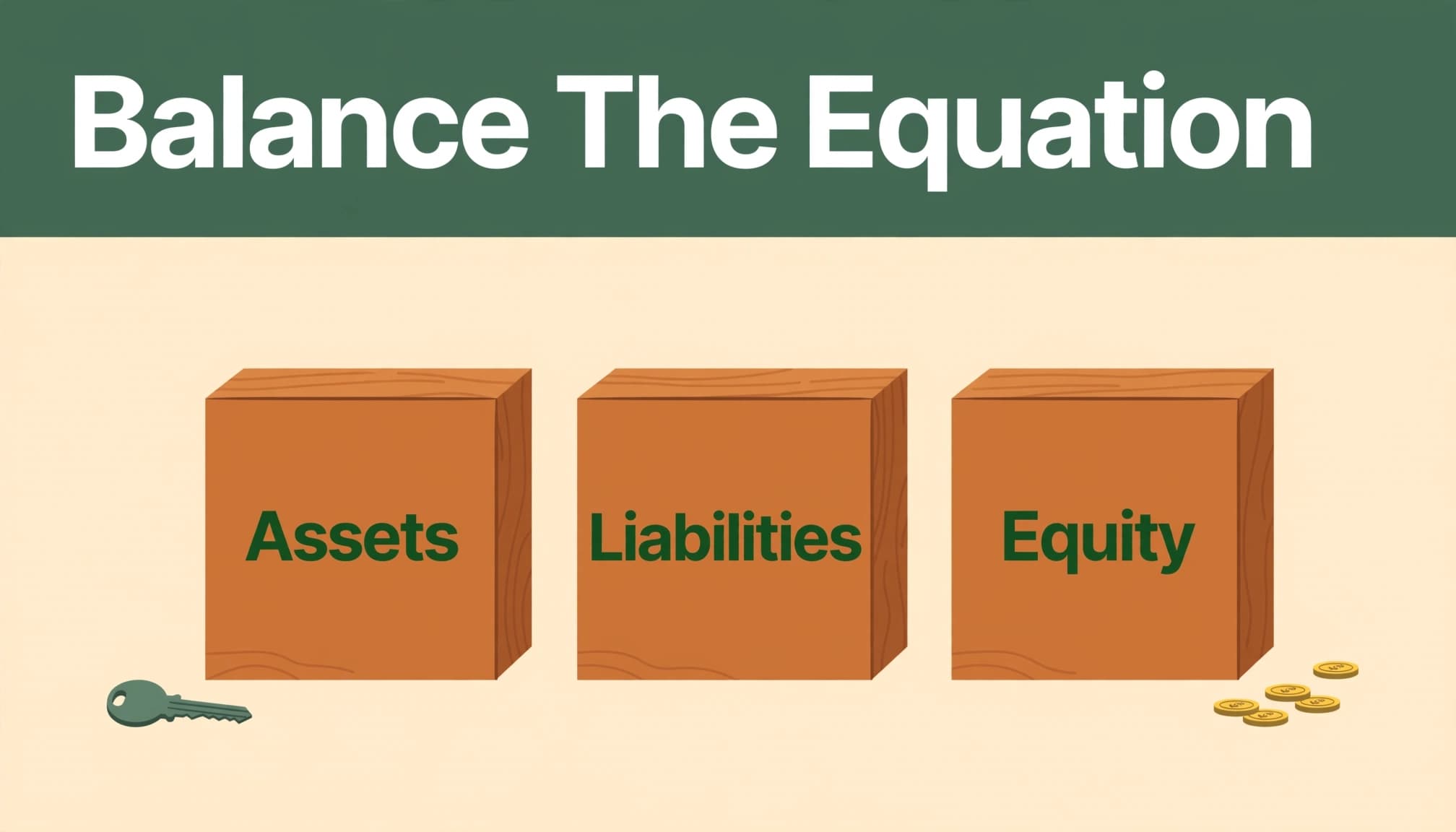
Every balance sheet follows one rule:
Assets = Liabilities + Owner’s Equity
If the numbers do not balance, something is missing, duplicated, or recorded in the wrong place. Accounting software may calculate this for you, but understanding the relationship helps you ask better questions.
Assets are what the business owns
Assets include cash, inventory, unpaid customer invoices, equipment, and other items with value to the business.
Accounts receivable is a common example. It is money a client owes you for work already completed or products already delivered. It is an asset, but it is not cash in hand yet.
Liabilities and equity explain where assets came from
Liabilities are amounts your business owes. Equity is the value left after you subtract those obligations from assets.
A sole proprietor or single-member business may see an owner equity label, while a corporation may label this category shareholders’ equity.
The formula for owner’s equity is:
Owner’s equity = Assets – Liabilities
If your business owns $18,500 in assets and owes $8,000, the remaining value is $10,500. That equity may include money you invested, profits kept in the business, and retained earnings from earlier periods.
Sort Assets and Liabilities Into the Right Buckets
The labels can sound formal, but they’re simple once you know what they mean. Current items are expected to turn into cash or be paid within the next year. Non-current items usually stay with the business longer.
Current assets and fixed assets
Current assets often include cash, accounts receivable, inventory, and short-term deposits. These are the resources that help you operate in the near future.
Non-current assets, sometimes called fixed assets, include items such as a business vehicle, camera equipment, furniture, or machinery. An expensive computer used for your business may be an asset rather than an ordinary monthly expense. Its value can also decline over time through depreciation.
Some intangible assets, such as recognized trademarks or purchased goodwill, may also appear on the balance sheet. Internally created brand value isn’t always recorded as an asset.
Here’s a simple balance sheet example for a small event-planning business:
| Assets as of September 30 | Amount |
|---|---|
| Business checking account | $7,500 |
| Unpaid client invoices | $4,000 |
| Supplies on hand | $1,000 |
| Equipment, after depreciation | $6,000 |
| Total assets | $18,500 |
The total includes more than the bank balance. That’s the point.
Current liabilities and long-term debt
Current liabilities are also called short-term liabilities, and they cover bills due soon. They can include accounts payable, credit card balances, and payroll obligations. Sales tax owed is a tax liability, while accrued expenses are unpaid costs already incurred. They may also include the next payment due on a loan.
Long-term liabilities are obligations that will take longer than a year to pay. A small business loan with several years remaining is a common example.
For the same event-planning business, accounts payable might be $1,500, a business card balance might be $1,000, and the remaining loan balance might be $5,500. Total liabilities are $8,000. With $18,500 in assets, the owner’s equity is $10,500.
Review the Balance Sheet With a Calm, Practical Routine
You do not need to stare at this report every day. A monthly review gives you a useful rhythm. If income is uneven, a short weekly check of cash, invoices, and upcoming bills can help you stay grounded.
A weekly profit check-in for entrepreneurs can also help you notice small concerns while they are still manageable.
Ask questions that lead to action
Pull up the current report and last month’s report. Then ask:
- Did cash increase because sales were collected, or because I used credit?
- Which invoices are still unpaid, and when will I follow up?
- Did accounts payable grow because of a planned purchase or because bills are piling up?
- Did I add debt, pay debt down, or move money into the business?
- Is my owner’s equity moving in a healthy direction over several months?
You can also use two simple ratios to add context. The current ratio compares current assets with current liabilities. Divide current assets by current liabilities to calculate it. The debt-to-equity ratio compares total liabilities with owner’s equity. Divide total liabilities by equity to calculate it.
For this event-planning example, $12,500 in current assets divided by $2,500 in current liabilities produces a current ratio of 5.0. Total liabilities of $8,000 divided by equity of $10,500 produces a debt-to-equity ratio of about 0.76.
A higher or lower result is not automatically good or bad. Industry norms, seasonality, loan terms, and upcoming cash needs all matter. Ratios are signals to monitor over time as part of your financial health. Ask an accountant before making business-specific borrowing or tax decisions.
A full bank account is not always available money. It may include client deposits, tax funds, or cash needed for bills next week.
Write down one concern and one opportunity after each review. Maybe you need to follow up on two invoices. Maybe it is time to stop using a subscription you no longer need. Small, clear actions build confidence.
Watch trends without panicking
One hard month does not mean your business is failing. Numbers are information. They give you a chance to pause, adjust, and keep moving with purpose.
Look for repeated patterns. If accounts receivable keeps growing, your invoicing or follow-up process may need attention. If credit card debt rises month after month, your operating costs may be higher than the cash coming in.
Compare similar periods when your business is seasonal. A December balance sheet may not be a fair comparison for a slower February. Compare this February with last February when possible.
Use the Balance Sheet Alongside Your Other Reports
A balance sheet cannot answer every money question by itself. It is one financial statement that works best beside your income statement and cash flow statement. Together, these reports support consistent financial reporting.
QuickBooks identifies these as the three basic financial statements for business owners. Each one tells a different part of the story.
Know which question each report answers
| Report | Main question it answers |
|---|---|
| Balance sheet | What do we own and owe right now? |
| Income statement | Did the business earn a profit over a period? |
| Cash flow statement | Where did cash come from and where did it go? |
Revenue is not profit. Profit is not the same as cash in your account. And an unpaid invoice is not money you can spend today.
Keep business reserves separate from household emergency savings when possible. Your business fund protects expenses like inventory, insurance, software, and client tools. Your personal reserve protects groceries, housing, child care, and family emergencies.
Understand why lenders and tax professionals ask
For a small business loan, a lender may review your business reports and repayment ability. They may also consider measures such as the current ratio and debt-to-equity ratio. For some SBA-backed financing, applicants may also need personal financial information. The SBA’s Form 413 guidance explains that this personal financial statement is used in reviewing repayment ability and creditworthiness for certain loan programs.
Your business balance sheet is not the same as your personal financial statement. Keep that distinction clear.
The IRS does not require every small business to attach a balance sheet to every tax return. Requirements depend on your entity type, tax form, and circumstances. Review current IRS small business tax guidance and speak with a qualified tax professional about your business.
A regular quarterly tax checklist for small businesses can help you keep reports, receipts, and estimated payments from becoming a last-minute rush.
Choose a System You Will Keep Current
A spreadsheet can work well for a newer business with manageable transactions. Excel or Google Sheets can help you list accounts, update balances, and save a monthly history.
As your business grows, accounting software such as QuickBooks or Wave may save time and reduce manual mistakes. QuickBooks explains how its balance-sheet reporting organizes what a company owns, owes, and retains as equity. Clean, current records also make it easier to prepare an application for a small business loan.
Keep the source records clean
Your report can only be as useful as the information behind it. Use a dedicated business bank account and card when possible. Save invoices, receipts, payment records, and notes about the business purpose of purchases.
Keep categories consistent. Do not call a design subscription “marketing” one month and “software” the next. Consistent categories make comparisons more honest.
Fix a balance sheet that will not balance
Do not force the equity number to make the report look right. Find the reason.
Start by checking for a transaction entered twice, a missing loan balance, a credit card balance recorded as an expense, or a personal withdrawal recorded as a business cost. Also review asset purchases, depreciation entries, and unpaid bills.
If you are not sure how an account should be classified, pause before changing it. A bookkeeper or accountant can help you correct the records without creating a bigger problem.
Frequently Asked Questions
How often should I review my balance sheet?
Review it monthly at minimum. Check cash on hand, unpaid invoices, upcoming bills, and debt payments weekly if your income changes often.
Is equity money I can take out today?
Not always. Equity is the value remaining after liabilities, not a promise that every dollar is available to spend. Your business may still need cash for taxes, bills, inventory, or a reserve.
What should I do if accounts receivable keeps growing?
Follow up on overdue invoices, review payment terms, and consider requiring deposits or shorter due dates. If clients routinely pay late, your cash flow needs a stronger plan.
Build Confidence One Review at a Time
Your small business balance sheet is not there to make you feel behind. It gives you an honest look at what your business can handle today.
Start with the date, check that assets equal liabilities plus equity, and pay attention to patterns over time. Clear numbers create calmer decisions, even when the next step is simply asking for help.