
How to Read Your Pay Stub and Catch Costly Errors
Your paycheck can look right at first glance and still carry an expensive mistake. One missed overtime hour, an old benefits deduction, or a raise that never reached payroll can take money from you.
You don’t need an accounting degree to protect your paycheck. When you review each pay statement with a simple routine, the numbers stop feeling like a foreign language. You can see what you earned, what came out, and whether your take home pay is correct.
Begin with the basic map, then check the few lines most likely to cost you.
Key Takeaways
- Review your pay period, hours, pay rate, gross pay, deductions, taxes, and net pay on every pay stub.
- Compare hours and earnings with your timecard, schedule, current rate, raise notices, and approved benefits elections.
- Use year-to-date totals to spot errors that repeat across multiple paychecks, and compare your final pay stub with Form W-2.
- If you find an error, save your records, document the issue, contact payroll or HR in writing, and request a corrected pay statement.
- Keep your pay stubs and related payroll records, since they may help with taxes, benefits applications, income verification, or a wage dispute.
How to Read Pay Stub Details Without Missing a Dollar
A pay stub, also called a paycheck stub, wage statement, or pay statement, is the record attached to your payment. It shows the work and earnings behind your take-home pay.
The exact layout depends on your employer, payroll provider, state, and country. Still, most statements contain the same core details. A plain-language payroll breakdown can also help when your employer uses unfamiliar labels or codes.
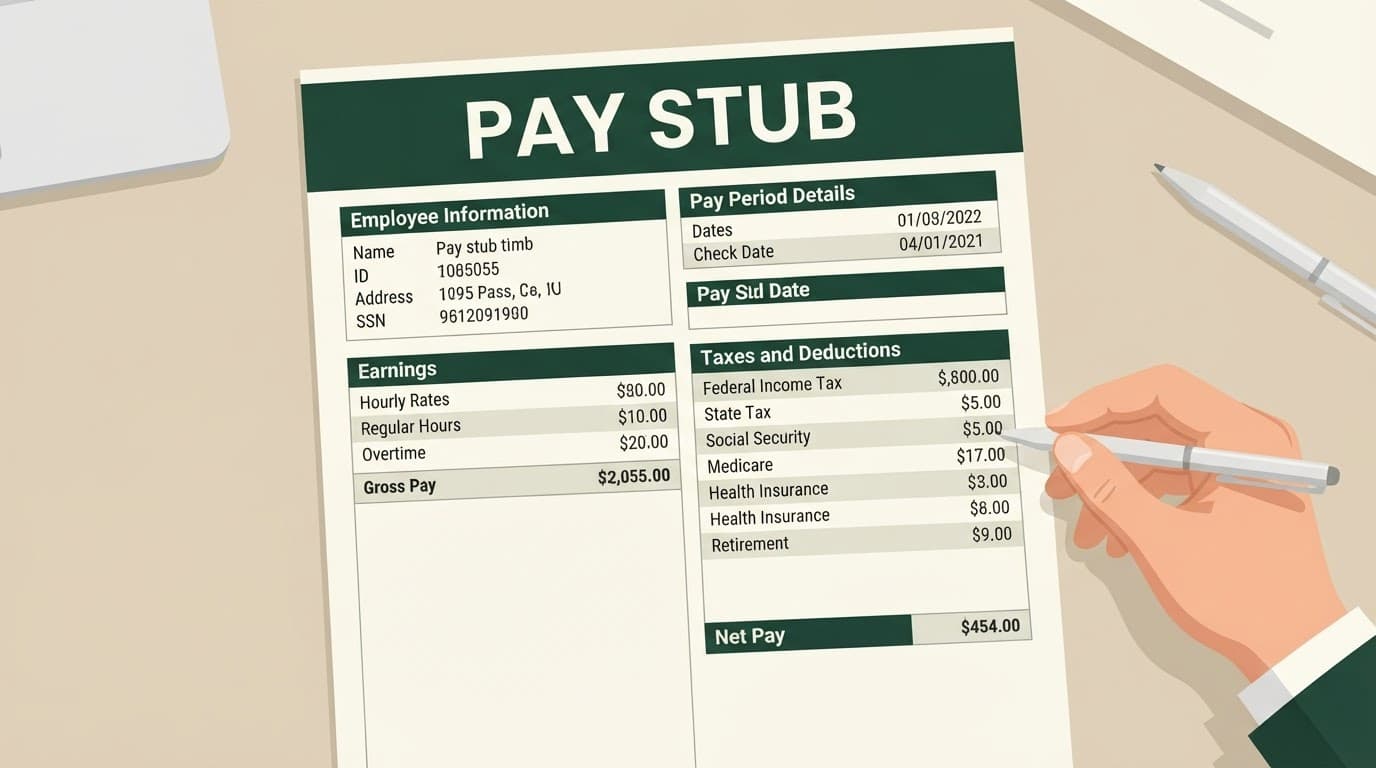
Use this quick guide when you first open your statement:
| Statement section | What it tells you | What to check |
|---|---|---|
| Employee and employer details | Your name, address, employer name, and ID number | Look for misspellings or an old address. |
| Pay dates and coverage | The pay period your wages cover and when you were paid | Confirm the dates match the work you’re reviewing. |
| Hours worked and rate | Regular hours, overtime hours, hourly rate, or salary amount | Match it to your timecard, schedule, and current pay rate. |
| Gross pay | Earnings before withholdings and other reductions | Confirm all wages, bonuses, PTO, and differentials are included. |
| Taxes | Federal, state, and local withholdings | Watch for an unexpected tax jurisdiction. |
| Deductions | Benefits, retirement contributions, dues, and other items | Check that every item is authorized and current. |
| Net pay and cumulative totals | What reached your bank account by direct deposit and the totals so far | Compare the current check with prior statements. |
Your reading order matters. On the pay statement, check the pay period dates, hours, rate, and earnings before reviewing reductions and the final deposit. If the earnings section is wrong, every number below it may be wrong too.
Follow the Money: Hours, Rates, and Gross Pay
For hourly workers, start with the time record on your pay statement. Hours worked should match your approved timecard. Overtime pay should usually appear as its own line with its own rate.
Under the federal Fair Labor Standards Act (FLSA), covered nonexempt employees generally receive at least one and one-half times their regular rate for hours over 40 in a workweek. The key word is workweek, not pay period. Your state, union agreement, or employment contract may provide more protection.
If you received a raise, look at its effective date. Then compare the rate on each affected pay stub. A retroactive raise can require back pay for hours already worked. That amount may show as “retro,” “adjustment,” or another payroll code.
For salaried employees, compare the amount shown with your normal salary divided by the number of pay periods in the year. Also check for unpaid leave, paid time off, commissions, bonuses, shift differentials, or expense reimbursements.
Gross pay is everything you earned before amounts are withheld or reduced. Net pay is what remains after those amounts come out. Net pay is the deposit you see in your bank account, but the full earnings figure tells the bigger story.
Understand Taxes, Benefits, and Other Deductions
Taxes and deductions can make a pay statement feel smaller fast. That doesn’t mean they’re wrong, but every line deserves a quick look.
Federal withholding is based largely on your W-4 form and your pay for that period. State income tax and local taxes may also appear, depending on where you live and work. FICA taxes include Social Security and Medicare.
Benefits deductions may be pre-tax deductions or post-tax deductions. Traditional 401(k) contributions, many health insurance premiums, health savings account contributions, and some commuter benefits can reduce taxable wages. They do not all affect every type of tax in the same way.
Post-tax amounts come out after applicable withholding. Roth retirement contributions, union dues, charitable gifts, some insurance products, wage garnishments, and repayment plans often fall into this category.
Your enrollment choices should match your pay stub. If you changed health plans, stopped a contribution, or left a role with union dues, don’t assume payroll received the update. Compare the deduction amount and effective date on your pay statement with your confirmation emails. These payroll basics can help you sort earnings and payroll entries into clear categories.
Use Accumulated Totals Before Tax Time
Year to date, or YTD, totals show what has accumulated since the start of the calendar year. They can reveal a problem that looks small on one paycheck but has been repeating for months.
A quick check is simple: the newest pay statement’s YTD amount should generally equal the prior statement’s cumulative amount plus the current amount. Corrections, voided checks, and year-end timing can cause exceptions, but unexplained gaps deserve a question.
Review YTD figures for gross pay, federal withholding, and FICA, including Social Security and Medicare. Check state income tax, other taxes, pre-tax deductions, and post-tax deductions.
Keep your final pay statement of the year and compare it with Form W-2 when it arrives. A difference isn’t always an error. A W-4 form change or pre-tax treatment can affect taxable wages and the comparison, but a large or confusing difference deserves review.
Check these figures on payday instead of waiting for tax season. Your future self will thank you when you need proof of income for a lease, loan, or benefits application.
Once you know your actual income, it is easier to build a plan around it. A 26-week money challenge is one simple way to tie savings goals to each pay period.
Red Flags That Deserve a Second Look
Most payroll errors are not dramatic. A missing half hour, duplicate deductions, or an outdated rate can slip onto a pay statement. Those small amounts add up.

A single incorrect check can be fixed. An error that repeats in the cumulative column can become much harder to untangle months later.
Watch for these warning signs:
- Regular or overtime hours on your pay stub don’t match your hours worked according to your timecard, approved schedule, or PTO record.
- Your hourly rate stayed the same after a documented raise, promotion, or shift change.
- Overtime pay is missing, calculated at the regular rate, or shows fewer hours than you worked.
- Benefit deductions continue after you change or cancel an election, including post-tax deductions tied to an outdated choice.
- A new deduction appears without an enrollment form or written explanation, such as a court order for garnishments.
- State or local taxes are withheld for a place where you did not live or work.
- A bonus or retroactive payment is missing from gross earnings, even if the net amount looks unusual.
A larger withholding amount on a bonus or retroactive payment isn’t automatic proof of an error. Payroll may withhold it differently than regular wages. Focus first on whether the gross amount is correct.
What to Do When You Find a Payroll Error
Don’t wait for another paycheck if money is missing. Gather your records while the dates and details are fresh.
- Save the pay stub and collect your payroll records, including your timecard, work schedule, offer letter, raise notice, benefits confirmation, and prior statements. Screenshot digital records if access might change.
- Write down the exact issue. Include the exact pay period, the relevant line item on the pay statement, what you expected to see, and the record supporting your concern.
- Contact payroll or HR in writing. Keep the message calm and clear: “My pay period ending [date] shows 76 regular hours, but my approved timecard shows 80. Please review and let me know when this will be corrected.”
- Ask for a corrected pay statement and corrected wage statement, along with the expected payment date. Ask how the correction will be paid, including whether it will use direct deposit. If taxes, benefits, or a multi-state work arrangement are involved, ask which work location and tax jurisdiction payroll used.
If payroll doesn’t respond or refuses to correct a clear mistake, follow your workplace’s escalation process. You may also contact your union representative, local labor agency, or a qualified employment professional. Keep every email and document in one folder.
Pay Stub Laws and Recordkeeping Vary
Rules for accessing pay information are not one-size-fits-all. Federal law requires covered employers to keep payroll records, but it doesn’t require every worker to receive paper or electronic documentation. State laws may require a written pay statement, electronic access, or print options. They may also require employee consent and itemized details, such as state income tax.
Federal record retention rules generally require covered employers to keep payroll records for at least three years. Records used to calculate wages, including timecards and work schedules, are often kept for at least two years. The IRS requires employers to retain employment tax records for at least four years. The period begins when taxes are due or paid, whichever is later.
Check state payroll requirements for a starting point, then confirm the rule with your local labor agency. Workers outside the United States should check their country’s rules for payroll documents. Local guidance always wins when requirements differ.
Frequently Asked Questions
What is the difference between gross pay and net pay?
Gross pay is the total amount you earned before taxes, benefits, and other deductions. Net pay is the amount left after those reductions and is generally what reaches your bank account.
How often should I check my pay stub?
Review your pay stub every payday while the hours, dates, and payroll changes are still fresh. A quick check can catch missing overtime, an outdated pay rate, or an incorrect deduction before the error repeats.
What should I do if my pay stub is wrong?
Save the pay stub and gather supporting records such as your timecard, schedule, raise notice, benefits confirmation, and prior statements. Then contact payroll or HR in writing with the pay period, incorrect line item, expected amount, and request for a corrected statement.
Why should I check year-to-date totals?
Year-to-date totals show how much pay, tax, and deductions have accumulated during the calendar year. Comparing them with the previous statement can reveal an error that has been repeated across several paychecks.
Does a larger tax withholding on a bonus mean payroll made a mistake?
Not necessarily, because bonuses and retroactive payments may be withheld differently from regular wages. First confirm that the gross bonus or payment amount is correct, then ask payroll to explain any unexpected withholding.
Your Earnings Record Is Part of Your Pay
Your pay statement is more than a document or portal download. It records your hours, earnings, benefits, and taxes withheld.
Give it five focused minutes each payday. Check the dates, earnings, deductions, and totals before an error becomes a pattern. Your work deserves accurate pay.