How to Choose a Business Name and Check Availability

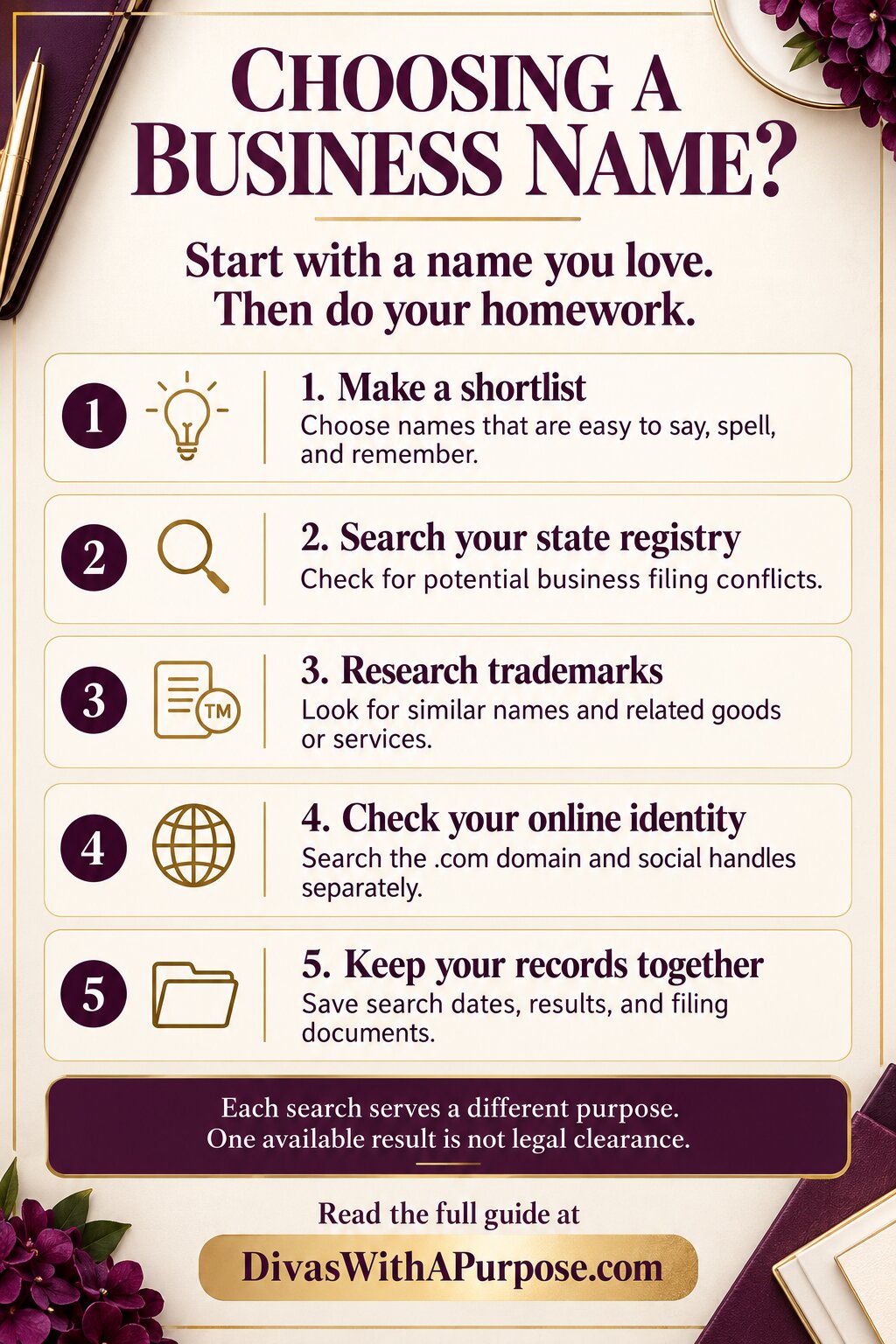
Choose a business name that’s easy to remember, fits your work, and leaves room for growth. Check business name availability in your state’s Secretary of State registry. Search a trademark database, domains, and social media handles separately; each search serves a different purpose.
Registration rules vary by jurisdiction, and a result in any one search doesn’t establish legal clearance. Review your preferred names before spending money on a logo, website, or printed materials.
Key Takeaways
- Start with a shortlist of names that are easy to say, spell, and remember, and that leave room for your business to grow.
- Search your state’s official business registry, the USPTO trademark database, domains, and social media handles separately. Each search answers a different question.
- A name that passes a state filing review doesn’t establish trademark rights or confirm that a domain or social handle is available.
- Keep your legal name and public-facing name consistent with the records and filings that apply to your business.
Choose a business name that can grow with you

Make it easy to say, spell, and remember
Start with a short list rather than one favorite. Consider what you offer, who you serve, and the feeling you want customers to associate with your business.
Say each name aloud. Ask someone to spell it after hearing it once. A name that needs repeated explanation may create extra work every time you introduce yourself.
Think beyond your first offer, too. A narrow product name or location reference can become limiting as your business grows. Give yourself room to expand without confusing the people you serve.
Separate your legal name from your public name
Your legal name is the name listed for your business entity on formation documents and other official records. A trade name, also called a DBA or fictitious business name, is the name you use publicly.
Those names can differ, but a public-facing name may require a separate filing. It doesn’t create another legal entity.
For an LLC, use the entity designation required by your state. Avoid wording that implies government affiliation, regulated services you aren’t authorized to provide, or a connection to another business.
Step 1: Check business name availability in your state
Start with the official business registry
Search the business filing office for the state where you’ll register. It’s often called the Secretary of State, though some states use another agency.
Use the registry to search your full proposed name, distinctive words, partial names, and spelling variations. Review matching records and their status, and don’t stop when the exact phrase returns no results.
For South Carolina founders, the official business name search provides records filed with the Secretary of State. Founders registering elsewhere should use their own state’s official registry.
Understand what the result tells you
A state search helps identify potential filing conflicts. It doesn’t establish trademark rights or confirm that a domain or social handle is free.
The state’s review follows its own rules about whether a name is distinguishable, restricted words, and entity types. A business name might pass that review while still conflicting with another company’s rights.
Adding “LLC” to a name doesn’t resolve a conflict over brand rights. The entity designation describes your business structure.
An inactive or canceled record doesn’t automatically mean its name is available. Some states continue holding names after cancellation.
California, Ohio, and Maryland have different rules
California compares names within the same entity type
California’s business name rules under SB 522, Chapter 361, Statutes of 2020, took effect January 1, 2021. They require corporation, LLC, and limited partnership names to be distinguishable from existing names of the same entity type. Names also can’t be likely to mislead the public.
California doesn’t compare these names against federal mark registrations, service mark registrations, or fictitious business names.
The California Secretary of State’s California name reservation guidance explains that its online Business Search is a preliminary business name search, not a formal name availability search.
Ohio defines which changes count
Under the Ohio name availability rules, punctuation, symbols, contractions, articles, conjunctions, entity designations, and singular-versus-plural changes don’t make names distinguishable.
Roman versus Arabic numerals, added letters, different word order, spelling variations, and foreign-language equivalents can make names distinguishable under Ohio’s filing rules. These differences don’t automatically remove trademark concerns. Ohio’s filing rules also apply to limited partnership names.
Ohio restricts words such as “bank,” “cooperative,” and “benefit.” Bank-related names require prior regulatory approval. A canceled corporation’s name remains held for one year after cancellation.
Maryland separates reservation from trade-name registration
The Maryland business naming process starts with the Business Express Name Search.
If you’re not ready to register, you can submit a name reservation form. If your business already exists and will operate under another name, Maryland provides a trade-name registration process. State filing availability and trademark rights are separate.

Step 2: Search the federal trademark database
Follow the USPTO search process
A state-approved name doesn’t give you federal rights or nationwide brand protection. Start with current USPTO guidance.
Use the USPTO trademark search guidance to begin:
- Go to the USPTO website.
- Open Trademark Search.
- Enter your proposed business name and search meaningful variations.
- Look for live registrations and pending applications.
- Review marks covering related goods and services.
- Read each relevant record’s status, owner, and description of goods or services.
This trademark search should include similar spellings and similar-sounding wording. An exact-name search alone can miss a potential conflict.
Look beyond identical words
A potential conflict can involve more than matching letters. Names can raise concerns because they sound alike, have similar meanings, or create similar overall impressions.
The goods and services matter, too. Customers may assume related offerings come from the same business even when the wording differs.
Don’t limit your review to one class. Related goods or services can appear in different classes. A dead record doesn’t establish that nobody still uses the name.
The federal trademark database is one part of clearance, not a guarantee that a name is safe to use. Search the web, state trademark records, and relevant marketplaces for existing use. Businesses can develop rights without federal registration.
If a similar name appears in related work, a trademark attorney can assess the risk before you invest further.

Step 3: Check the .com domain and social handles
A domain search tells you whether a web address is available. A platform search checks whether a username is available on that platform. These online checks are separate from state registry and federal searches, and neither grants trademark rights.
Check the exact .com domain before committing. If it’s taken, visit the address and see whether an active business uses it. A different extension won’t solve a conflict with an existing brand.
Search social media platforms your customers use, including Instagram, Facebook, LinkedIn, and TikTok where relevant. Check display names as well as handles.
Our guidance on choosing social media platforms can help you focus on channels that fit your audience and capacity.
You don’t need every possible account. Keep a clear, consistent identity across the social media channels you’ll maintain.
If your preferred handle is unavailable, a simple, accurate modifier may help. Avoid a complicated string of numbers or underscores that customers will struggle to remember.
Secure suitable domains and handles once your legal searches support moving forward with your business name.
Reserve your name or give yourself another option
A name reservation can hold a name while you prepare formation paperwork. It doesn’t form your company or give you legal protection.
California and Ohio offer different reservation periods and fees:
| State | Reservation period | Reservation fee |
|---|---|---|
| California | 60 days | $10 |
| Ohio | 180 days | $39 |
California doesn’t allow consecutive reservations, so you can’t reserve the name for another 60 days without a one-day gap.
That timing matters when you’re balancing business preparation with work, family, and other responsibilities. Reserve when you have a realistic plan for filing.
What if your favorite name is taken? Return to your shortlist. Choosing another business name now can be easier than replacing signs, packaging, and customer-facing accounts later.
If the issue is a registry conflict, a meaningful wording change may satisfy the state’s rules. If it’s a trademark concern, a small spelling change may leave the same problem.
An unavailable domain or handle can sometimes be purchased, but buying it doesn’t transfer trademark rights unless a separate agreement provides for them. Don’t pay for an address before resolving the brand question.
Keep your chosen name consistent after registration
Once your filing is accepted, save the approval documents and record the exact legal name, including its entity designation.
Use that name consistently on tax records, banking documents, invoices, and applications where the legal entity name is required. Matching business identifiers also supports the groundwork for building business credit.
Keep your public-facing name consistent across your website, signage, social media accounts, and customer communications. If it differs from your legal name, complete any required trade name filing.
For an eligible business, our Google Business Profile checklist explains how to present the name customers recognize. Don’t add promotional wording or extra keywords to the business name to chase visibility.
Create one reference document with your legal name, public name, address, phone number, website, and business email. It gives you a dependable starting point whenever you open an account or update a listing.
Keep copies of your searches and reservation or filing documents together. Record the search dates, too, so you know what you reviewed.
Frequently Asked Questions
What does a state business name search tell me?
A state registry search can identify potential filing conflicts under that state’s rules. It doesn’t establish trademark rights or show whether a domain or social handle is available.
Does a state-approved name mean I can use it as a trademark?
No. Search the USPTO database for similar marks covering related goods and services, and check for existing use elsewhere. Businesses can develop rights without federal registration.
Do I need a DBA if my public name differs from my legal name?
A public-facing name may require a separate trade-name or DBA filing, depending on your jurisdiction. A DBA doesn’t create another legal entity.
What should I do if my preferred business name is unavailable?
Return to your shortlist and consider a meaningful wording change, especially if the concern is a trademark conflict. Resolve the brand question before paying for a domain or handle.
Move forward with a name you can support
Your business name should feel right for your purpose and hold up under practical review. Separate searches help you understand state filing rules, trademark concerns, and the online identity available to you.
Start with a shortlist, work through each search, and reserve or register when you’re ready. You can move forward with enthusiasm while giving your business a thoughtful foundation.