
Calculate an Affordable Car Payment Before You Buy
A shiny car can make almost any monthly car payment look harmless. But if that payment leaves you stressed before the month is over, the car costs more than its price tag.
An affordable car payment leaves room for your bills, your goals, your family, and a little breathing room when life happens. Start with your real take-home pay and budget, not the number a dealership says you qualify for.
Key Takeaways
- Start with your monthly after-tax take-home pay, then subtract essential expenses before setting an affordable car payment.
- Keep the payment around 10% to 15% of net income when possible, and keep total transportation costs under about 20% of net income.
- Budget for insurance, fuel, maintenance, registration, taxes, parking, and fees—not just the loan payment.
- Work backward from your payment target to find a safe vehicle price, and compare APR, loan term, total interest, and lender fees.
- Test your budget for 30 days before buying by setting aside the estimated payment and ownership costs.
How to Calculate an Affordable Car Payment From Your Take-Home Pay
Start with your monthly after-tax take-home pay, the money that reaches your checking account after taxes, health insurance, retirement contributions, and other deductions. Gross income may look better on paper, but you can’t spend money you never receive.
Use this simple process before you begin shopping:
- Write down your average monthly after-tax take-home pay. If your income changes month to month, use the lowest amount from the last three months.
- Subtract essential monthly expenses, including rent or mortgage, groceries, childcare, utilities, credit card payments, student loans, and other debt obligations.
- Set a car payment range. A common guideline is keeping the monthly car payment between 10% and 15% of that income.
- Set a full transportation limit. Your payment, insurance, fuel, maintenance, registration, and parking should ideally stay under about 20% of net income.
Say you bring home $4,200 each month. Ten percent is $420, and 15% is $630. That gives you a starting payment range, but it isn’t permission to spend $630.
If you already have high rent, debt payments, or family expenses, your comfortable number may be closer to $300. Your financial life has to fit inside the budget too.
If a payment only works when every paycheck arrives on time and nothing breaks, it isn’t truly affordable.
Budget for the Full Cost of Car Ownership
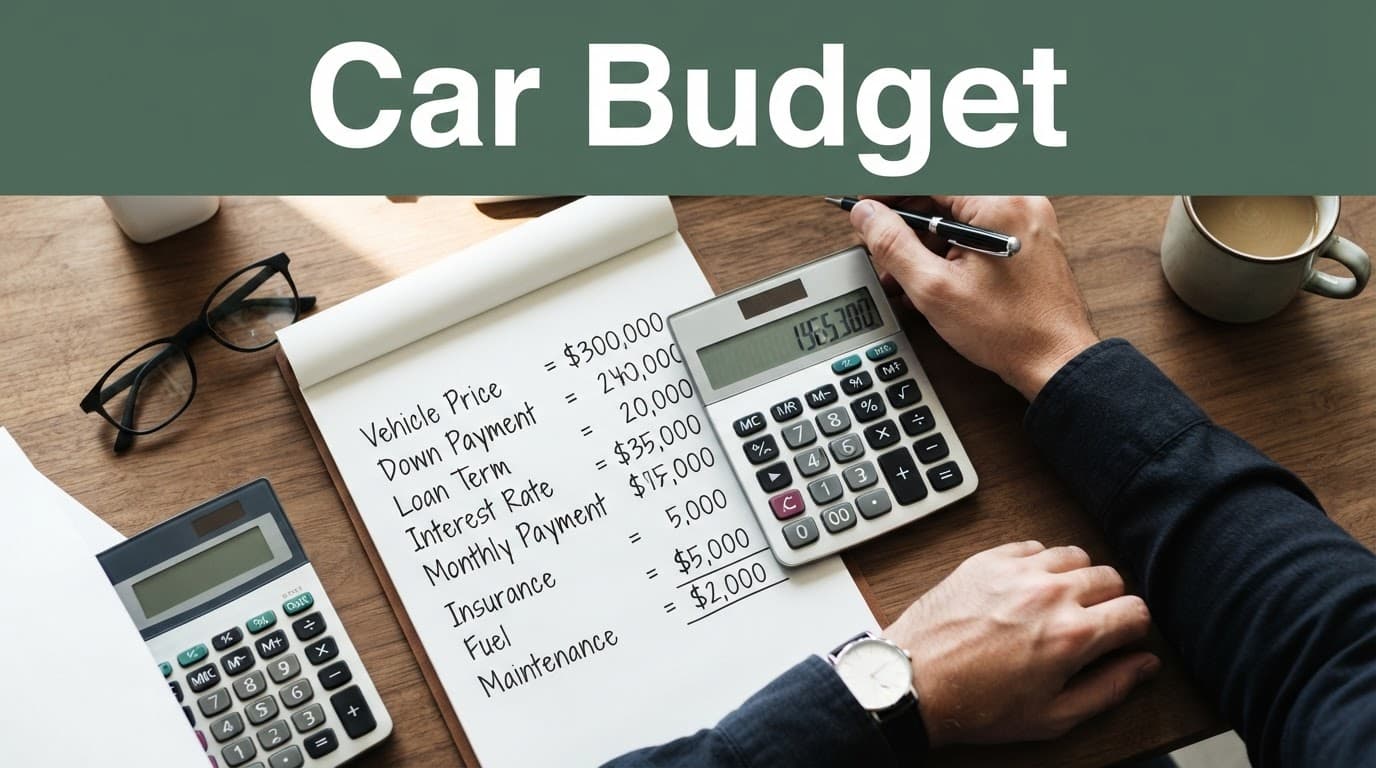
The monthly loan payment is only one part of the total cost of ownership. Before you fall in love with a vehicle, estimate its full monthly cost.
Call your car insurance company for a quote using the specific vehicle identification number, or VIN, when possible. Insurance premiums can vary widely between two cars with similar sticker prices.
Build these costs into your monthly transportation budget:
- Use an actual insurance quote, not a guess based on what you paid years ago.
- Estimate fuel based on your commute, weekend driving, and the vehicle’s fuel economy.
- Set aside money for maintenance costs, including oil changes, tires, brakes, repairs, and routine service.
- Include annual registration fees, local property or excise taxes, parking, and tolls.
- Ask about sales tax and fees, including title, documentation, and dealer charges, before signing anything.
Let’s return to the household with $4,200 in after-tax take-home pay. If you want total car costs under 20%, your transportation limit is $840.
Insurance, fuel, maintenance, and registration use $440 of that limit. That leaves about $400 for the payment, a much clearer number than asking, “What can I get approved for?”
Keep some cash outside your down payment for life’s surprises. A car purchase shouldn’t drain the money you need for a job loss, a medical bill, or a home repair. These tips to grow your emergency fund can help you protect that cushion while planning ahead.
Turn Your Monthly Budget Into a Vehicle Price
A standard auto loan calculator starts with the vehicle price and tells you the payment. A car affordability calculator works in reverse. You begin with the monthly payment you can manage, then work backward to find a safe purchase price.
For example, a $400 payment at an 8% annual percentage rate (APR) over 48 months supports a loan amount of about $16,350. That figure becomes your starting loan amount. Add your available cash, then subtract the taxes and fees you must cover.
| Part of the calculation | Example amount |
|---|---|
| Monthly payment target | $400 |
| Loan term and APR | 48 months at 8% |
| Maximum loan amount | About $16,350 |
| Down payment | $2,500 |
| Trade-in equity | $2,000 |
| Estimated taxes and fees | $1,600 |
| Approximate purchase price | $19,250 |
In this example, the math is $16,350 plus $2,500 plus $2,000, minus $1,600. Your safe vehicle price is about $19,250, not $25,000 because the dealership found a way to stretch the loan.
Your trade-in value only counts after subtracting what you still owe. If a dealer offers $8,000 but your current payoff is $6,000, you have $2,000 in trade-in equity. If you owe more than it is worth, that negative equity raises your new loan amount.
Use a tool such as the Bank of America auto loan calculator to compare financing options. Change the APR, term length, cash, and vehicle price to see how each input changes the loan amount. Seeing the numbers move is a powerful reminder that every choice affects the total.
Before you settle on a price, check your state and local tax requirements. Sales tax, title fees, registration, and dealer charges can add thousands to the amount financed.
Use Repayment Length and APR as Guardrails, Not Loopholes
You may hear about the 20/4/10 rule for buying a car. It suggests making a 20% down payment, financing for four years or less, and keeping total transportation costs below 10% of gross income.
It is a helpful guardrail, not a guarantee. Some families need a lower payment because childcare, housing, or debt already takes a large part of their income. Others can put more down because they have savings and few monthly obligations.
A longer loan term can lower the monthly payment, but it doesn’t make the car cheaper. It often does the opposite.
For that same $16,350 loan at 8% APR, the difference looks like this:
| Loan term | Approximate payment | Approximate interest paid |
|---|---|---|
| 48 months | $400 | $2,835 |
| 72 months | $286 | $4,271 |
The 72-month payment looks easier at first. Yet you would pay about $1,436 more in interest and could owe more than the car is worth for longer. Choose the shortest term that fits your budget without squeezing it dry.
Your credit score also affects your auto loan interest rate. Recent Experian averages show why offers differ, with rates for a new car and used car varying by credit tier. Review average auto loan rates by credit score before assuming the advertised rate is yours. Use current auto loan rates as a benchmark before visiting a dealer. Ask which credit tier an advertised offer assumes, then compare lenders within your actual credit tier.
A credit union may provide a useful comparison point. Get pre-approvals from a credit union, your bank, and at least one reputable online lender before you visit a dealership. Compare these financing options with dealer financing. Review the APR, loan term, monthly payment, total finance charge, and lender fees. Current offers vary widely, as shown in LendingTree’s auto loan rate marketplace.
A pre-owned vehicle can offer more value because its purchase price is lower. Still, APRs may be higher for older vehicles, which may need repairs sooner. Compare the full cost, not only the sticker price or the monthly payment.
Give Your Car Budget a 30-Day Test Drive
Before signing paperwork, do a 30-day budgeting dry run. Put your estimated payment and ownership costs into a separate savings account for one month.
Using the earlier example, that means setting aside $400 for the payment plus $440 for insurance, fuel, maintenance, and registration. If setting aside $840 creates stress, that is useful information. Lower the vehicle price, save a larger down payment, or give yourself more time.
A down payment is not something you need to force overnight. A focused plan to save $1,000 in 90 days can help you build momentum without using credit for expenses you could pay in cash.
When you are ready to negotiate, ask for the out-the-door price in writing and compare it with your financing options. Use current auto loan rates as a benchmark to see whether dealer financing is competitive. Review the APR, number of payments, total amount financed, and every fee before you agree. Take the paperwork home if you need time. A good decision can wait one night.
Frequently Asked Questions
What is an affordable car payment?
An affordable car payment fits comfortably within your budget after essential expenses and savings goals are covered. A common starting guideline is 10% to 15% of monthly take-home pay, but your personal number may be lower.
Should I budget for more than the monthly loan payment?
Yes. Include insurance, fuel, maintenance, registration, taxes, parking, tolls, and other ownership costs in your transportation budget. These expenses can reduce the payment you can safely afford.
Does a longer loan term make a car more affordable?
A longer term lowers the monthly payment but usually increases the total interest you pay. It can also leave you owing more than the vehicle is worth for a longer period, so choose the shortest term that fits your budget.
How can I test whether a car payment fits my budget?
Try a 30-day budgeting dry run by putting the estimated payment and ownership costs into a separate savings account. If setting aside that amount creates stress, lower the vehicle price, increase your down payment, or wait and save more.
Your Budget Gets the Final Say
An affordable car is not the most expensive vehicle a lender will approve. It is the one that gets you to work, supports your family, and still leaves room for the life you’re building.
Start with take-home pay, account for every ownership cost, and choose a realistic purchase price. Peace in your budget matters more than a vehicle that stretches it too far.